When Apocalypto arrived in December 2006, it looked like an unlikely Hollywood product: a big-budget, R-rated action film set in a pre-Columbian Mesoamerican jungle, with no major stars and dialogue entirely in Yucatec Maya. Nearly two decades later, it remains one of the most unusual studio-backed films of its era. This article discusses the film's plot and ending.
The Film at a Glance
- Director: Mel Gibson
- Writers: Mel Gibson and Farhad Safinia
- Released: December 2006, with Touchstone Pictures handling U.S. distribution
- Language: Yucatec Maya, with English subtitles
- Budget: reported at around $40 million
- Worldwide gross: roughly $120 million
- Running time: about 139 minutes
After The Passion, a Bigger Gamble
After the enormous success of The Passion of the Christ (2004), which was performed in Aramaic and Latin, Mel Gibson had the leverage to try another ambitious, subtitled project. He co-wrote the script with Farhad Safinia and produced it through his company, Icon Productions, with a budget reported at around $40 million.
The decision is easier to understand in the context of Gibson’s career. As a director he had already shown, with Braveheart in 1995 and The Passion of the Christ, that he was drawn to stories of suffering, endurance and sacrifice on a large physical scale. Apocalypto continued that interest, but it moved the setting to a place and period that mainstream cinema had rarely visited. A studio willing to pay for a film in a language most of its audience could not understand was making a bet on the strength of the director’s name and the appeal of a pure adventure story.
What the Title Means
The title comes from a Greek word that means to uncover or reveal, and Gibson has used it to signal a story about a hidden truth coming into view. The word is related to “apocalypse,” which most English speakers associate with catastrophe, but in its original sense it is closer to a revelation. That double meaning suits a film about a society approaching collapse and a young man who discovers what lies beyond the world he knows.
A Chase Disguised as an Epic
Gibson framed the story as a survival thriller set against a civilization in decline. The film opens with a line often attributed to historian Will Durant, suggesting great civilizations are destroyed from within before conquest from outside. The plot follows Jaguar Paw, a young hunter whose village is raided, and who escapes sacrifice in a decaying Maya city and races home through the forest to save his family. In structure it is closer to a chase movie than a historical epic.
The first act establishes a peaceful forest community, with its hunting traditions, humor and family bonds, before the raid shatters it. Jaguar Paw, who is the son of the village leader Flint Sky, hides his pregnant wife, Seven, and their young son in a deep pit before he is captured. The middle of the film takes the prisoners to a city where the ruling class conducts sacrifices to appease the gods, and the final movement is a long pursuit as Jaguar Paw flees back toward the pit where his family waits. Because the story is so simple to follow, the film depends on pacing, geography and physical performance, not on dialogue.
The ending introduces the arrival of Spanish ships on the coast, which reframes the story as the beginning of a larger change. Jaguar Paw and his family choose to return to the forest rather than follow the strangers, an ending that critics have read as a hopeful retreat or as an uncertain one.
A Cast Without Stars
Rather than hire famous actors, the production held casting searches across Mexico and North America, looking for performers of Indigenous descent. Rudy Youngblood, who played Jaguar Paw, came to the film with little acting experience and a background as a Native American dancer. Raoul Trujillo, Dalia Hernández, Gerardo Taracena and Morris Birdyellowhead filled out a cast that audiences largely didn't know.
The key roles were distributed across that group. Birdyellowhead played Flint Sky, Hernández played Seven, Trujillo played the war captain Zero Wolf, and Taracena played Middle Eye, one of the warriors who chases Jaguar Paw. Because the performers were not widely recognized, viewers could accept them as members of the world on screen rather than as famous faces in costume. That choice also gave the film a physical authenticity, since many of the actors were chosen for their athletic ability as much as for their experience.
Speaking Maya on a Hollywood Set
The cast learned their lines in Yucatec Maya, still spoken by many people today, with the help of language coaches. Many performers delivered the dialogue phonetically, and the film's heavily physical performances help carry the story across the language barrier.
Studio films in languages other than English are rare, but they are not unprecedented. Dances with Wolves (1990) used Lakota with subtitles in key scenes, and Gibson’s own The Passion of the Christ proved that a subtitled film could find a very large audience. Apocalypto went further by building an entire action film around a language that has few speakers outside the Yucatan Peninsula and surrounding areas. For viewers who were hearing Yucatec Maya for the first time, the language became part of the film’s texture, giving the jungle setting a sonic identity as distinct as the visuals.
Shooting in Veracruz
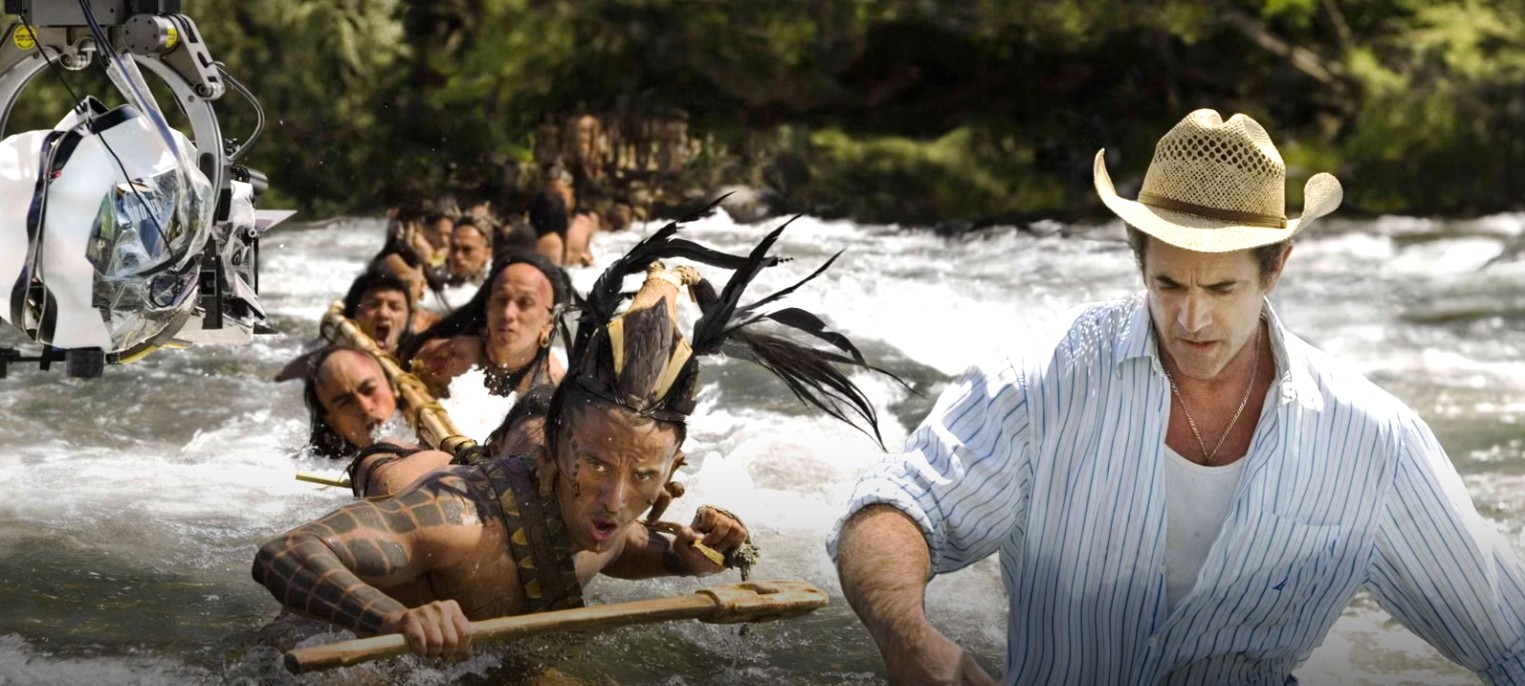
Principal photography took place in the state of Veracruz, Mexico, in tropical jungle terrain. The production built large sets, including a Maya city, and conditions were demanding: heat, humidity, water, mud, and long physical sequences. Production designer Thomas E. Sanders led the construction of the city, which blended physical sets with digital extension work to create the sense of a sprawling urban center.
Digital Cameras in the Jungle
Cinematographer Dean Semler shot the film on Panavision's Genesis digital camera, one of the earliest major studio features to do so. The digital format suited the film's style, with its mobile handheld camerawork, dim jungle interiors, and long running sequences, and it let the crew shoot in difficult locations with greater flexibility than film stock would have allowed.
Semler was an experienced choice. He had won the Academy Award for cinematography for Dances with Wolves, a film that also dealt with Indigenous culture and subtitled dialogue, and he brought a sense of the natural landscape to the jungle sequences. In 2006 digital cinematography was still new at the top level of studio production, and many filmmakers remained skeptical of it. A movie built around dense foliage, low light and constant motion was a demanding test, and its visual style helped show that digital cameras could handle rough conditions.
Action Built on Practical Stunts
Apocalypto is remembered for its extended action, particularly the second half's pursuit through the forest. Sequences include a leap off a waterfall, a trap-filled jungle chase, a quicksand pit, and a jaguar attack. The filmmakers relied heavily on stunt work, prosthetics, and makeup, and the film's makeup and sound work earned it Academy Award nominations for Best Makeup, Best Sound Editing, and Best Sound Mixing.
James Horner's score added to the atmosphere, mixing orchestral writing with Indigenous-style instruments and percussion to give the film a distinctive sonic texture.
The emphasis on physical effects meant that much of what audiences see was created in front of the camera. Makeup and prosthetics carried the film’s depiction of painted warriors, ritual markings and injuries, while the sound team built the world of the forest from layers of animal calls, wind and water. The three Oscar nominations were all in craft categories, which reflects how much of the film’s impact came from technical work rather than from star performances or a conventional awards campaign.
What Made It Unique
Language and casting. An entire studio-backed action film in a Maya language, with Indigenous and largely unknown performers, was almost unheard of in Hollywood.
Structure. It strips a historical setting down to a primal chase, favoring momentum and visual storytelling over exposition.
Technology. Its early embrace of high-end digital cinematography foreshadowed where the industry was heading.
Intensity. Its graphic violence and relentless pacing made it a divisive but memorable viewing experience.
Controversy and Historical Accuracy
The film drew significant criticism from historians and archaeologists. Many pointed out that it blends elements of different Mesoamerican cultures, such as the Aztec-style heart sacrifice, with Maya imagery, and that its portrayal of the Maya as violent and collapsing from within oversimplifies a complex history. The timeline is also compressed, with the arrival of Spanish ships at the end invoking a period well after the classic Maya collapse. Some Indigenous commentators and scholars felt it reinforced stereotypes, while others praised the visibility given to Indigenous actors and languages.
The historical gap is easy to describe. The classic period of Maya civilization, when great cities such as Tikal and Palenque flourished, ended centuries before the Spanish reached the Yucatan coast in the early sixteenth century. The Aztec, or Mexica, were a separate culture centered in the Valley of Mexico, and the large-scale heart sacrifice associated with them was not a typical Maya practice in the form the film shows. By combining these elements into a single setting, the film created an impression of a unified “ancient Mesoamerica” that does not match how the region’s cultures actually developed.
That criticism points to a broader issue about how films use history. A story can be effective as a chase thriller while still giving viewers a misleading picture of the people it depicts, and the discussion around Apocalypto shows how difficult it can be to separate those two qualities. Gibson has described the film as an adventure story rather than a documentary, a distinction that critics accepted in part and challenged in part.
A Release Under a Cloud
Gibson himself was also in the news. His arrest in the summer of 2006 and the controversy over his remarks cast a shadow over the release, though the film still performed solidly, earning roughly $120 million worldwide.
Against a budget of around $40 million, that total represents a clear commercial return, particularly for a subtitled film with an unknown cast. Whether it would have performed even better without the controversy is impossible to say, but the box office result showed that audiences were willing to watch a film in Yucatec Maya when it was packaged as a tense, fast-moving adventure.
Legacy
Apocalypto endures as a bold, polarizing piece of filmmaking: visually immersive, technically ambitious, and historically contested. Whether viewed as a thrilling survival story or a flawed portrayal of Maya civilization, it remains a rare example of a major studio backing a film in an Indigenous language, and a striking reminder of how far a director with leverage and a strong vision can push the boundaries of mainstream cinema.
Two decades on, the film is often discussed in two ways at once. Film students and craft-minded viewers return to its camerawork, sound design and editing as a model of sustained momentum, while historians and Indigenous scholars use it as a case study in how popular entertainment can shape public ideas about the past. Both conversations remain active, and both are part of the reason the film is still watched, argued over and recommended long after its release.