The news that sent shockwaves through action and crime cinema circles is officially confirmed: Emily Blunt, Benicio del Toro, and Josh Brolin are reuniting for Sicario 3. Directed by Padraic McKinley and penned by Peaky Blinders mastermind Steven Knight, the third installment sets out to pull the franchise back into the spotlight.
While fan excitement is at an all-time high, the announcement arrives with a crucial question hanging over the project: can a third film recapture the haunting, claustrophobic brilliance of the 2015 original, or will it lean into the slick action tropes that diluted its 2018 sequel?
To understand why Sicario 3 represents a pivotal crossroads for modern crime thrillers, we have to look back at what made Denis Villeneuve's vision a masterclass, and why reuniting the core trio is only half the battle. This article discusses plot details from the first two films.
What the Announcement Confirms
- Returning stars: Emily Blunt, Benicio del Toro and Josh Brolin
- Director: Padraic McKinley
- Writer: Steven Knight, creator of Peaky Blinders
- Production banners: Black Label Media and Thunder Road
Beyond those points, the details that audiences usually look for, such as a release date, a plot summary and the rest of the cast, are not part of the information gathered in this article. That gap is worth keeping in mind as the project develops, since any claim about the story itself at this stage would be guesswork.
The Retrospective: Why Sicario 3 Needs Denis Villeneuve's Original Grit
When Sicario debuted in 2015, it wasn't marketed as the foundation for an action franchise. It was a bleak, existential thriller about moral bankruptcy on the US-Mexico border. Denis Villeneuve, backed by Roger Deakins' oppressive cinematography and Jóhann Jóhannsson's terrifying, industrial score, crafted a world where rules didn't exist and hope was an early casualty.
The film premiered in competition at the Cannes Film Festival and went on to earn three Academy Award nominations, for cinematography, original score and sound editing. That recognition was unusual for a violent crime thriller, and it reflected how much of the film’s power came from craft rather than from plot. For the sequel to justify its existence, it has to carry some of the same ambition.
What “Sicario” Means
The title is a Spanish word for a hired killer, and it traces back to the sicarii of the ancient world, a name associated with assassins who used short daggers. In the film, the word applies most directly to Alejandro, the quiet consultant played by Benicio del Toro, whose true purpose does not become clear until the final act. The title therefore functions as a kind of slow reveal, pointing to a figure whom both the audience and the main character underestimate.
1. Emily Blunt Was the Audience's Moral Compass
The biggest flaw of 2018's Sicario: Day of the Soldado wasn't its action sequences. It was the absence of FBI Agent Kate Macer (Emily Blunt). Kate was never meant to be a traditional action hero. She was an idealist pushed into an abyss, serving as the audience's surrogate.
Without her rigid insistence on the rule of law, Matt Graver (Josh Brolin) and Alejandro Gillick (Benicio del Toro) were simply two dangerous operatives engaging in unhinged tactical ops. Blunt's return restores the essential friction that drove the original: the conflict between human morality and state-sanctioned violence.
2. Dread Over Firepower
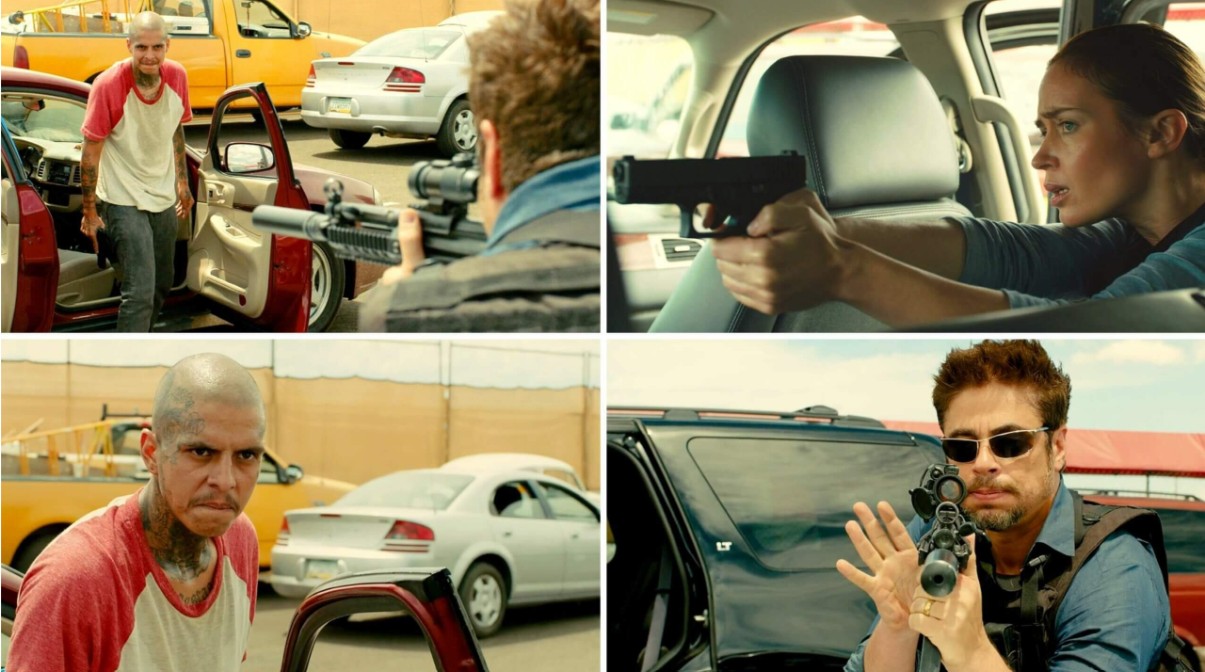
Villeneuve understood that real fear isn't generated by endless gunfights, but by the excruciating wait before a single shot is fired. The legendary Juarez border gridlock scene remains a benchmark in modern filmmaking because of its patience. The camera lingers on sweating hands, side-view mirrors, and distant, unidentified threats.
Sicario 3 screenwriter Steven Knight and director Padraic McKinley must resist the urge to turn the film into a standard blockbuster shoot-'em-up. The franchise thrives when the atmosphere feels suffocating.
The Juarez sequence is a useful model because it turns something ordinary, a traffic jam, into a pressure cooker. Nothing about the setting is spectacular. Cars sit bumper to bumper under a hot sky, and the threat is conveyed through glances, hand positions and the sense that anyone nearby could be dangerous. When violence finally arrives, it is brief and sudden, and its brevity is what makes it feel more realistic and more upsetting than a prolonged exchange of gunfire would. A third film that wants to match this effect needs scenes built on the same principle: wait, watch, and let the audience imagine the worst.
3. No Clean Victories or Heroic Arcs
In the original Sicario, nobody wins. Kate is coerced at gunpoint to sign away her integrity, Alejandro disappears into the night after executing a cartel kingpin's family, and Matt calmly returns to his shadow war.
Day of the Soldado strayed toward a softer narrative, attempting to humanize Alejandro through a protector-child dynamic. For Sicario 3 to succeed, it must embrace Taylor Sheridan's original ethos: the drug war is an unwinnable, cyclical nightmare that corrupts everyone who touches it.
A New Creative Team Takes the Wheel
The first film was directed by Villeneuve from a script by Taylor Sheridan, and the second was directed by Stefano Sollima, again from a Sheridan script. The third film brings in a different set of filmmakers, with McKinley directing and Knight writing. Each change in the creative team shifts what the franchise looks and sounds like, which is why the question of tone matters so much.
Knight’s background suggests an interest in dark, character-driven crime stories. Beyond Peaky Blinders, his screenwriting credits include Dirty Pretty Things and Eastern Promises, two films that treat criminal underworlds as places of exploitation and moral compromise rather than glamour. That record points toward a writer comfortable with the bleak side of the genre, although how it translates to the specific world of Sicario remains to be seen. McKinley, as the director, will be responsible for the visual and rhythmic choices that Villeneuve and Deakins made so distinctive in 2015, and the gap between that earlier achievement and a new director’s style is part of what makes the project so closely watched.
Deep Dive: The Uncompromising Legacy of the Sicario Trilogy in Modern Crime Cinema
Even as Hollywood shifted heavily toward capes, CGI spectacles, and sanitized blockbusters throughout the late 2010s, the Sicario series carved out a distinct legacy. It stands alongside films like Heat, No Country for Old Men, and The Town as one of the few contemporary adult-oriented crime sagas.
| Film Element | Sicario (2015) | Sicario: Day of the Soldado (2018) | What Sicario 3 Must Achieve |
|---|---|---|---|
| Perspective | Moral outrage through an outsider's eyes (Kate Macer) | Tactical operations through military enforcers | A clash between systemic corruption and personal accountability |
| Visual Tone | Sun-bleached deserts, night-vision green, deep silhouettes | High-contrast action sequences, military tactical aesthetics | Atmospheric dread combined with tight character-driven framing |
| Core Theme | The illusion of law and order in covert intelligence warfare | Rogue escalation and lawlessness in border enforcement | The inevitable reckoning when past actions catch up to all parties |
A Moral Spectrum with No True Heroes
What separates Sicario from standard cartel thrillers is its nuanced gray scale. It refuses to depict federal agencies as righteous guardians or cartels as cartoonish villains. Instead, it frames the entire ecosystem as a bloody machine where bureaucracy and law enforcement act with the same ruthless pragmatism as the syndicates they claim to combat.
Setting the Gold Standard for Sound and Cinematography
Jóhann Jóhannsson's score, particularly the track "The Beast," did not merely accompany the visual images; it haunted them. Combined with Roger Deakins' aerial shots of the border fence cutting through the desert like an open wound, Sicario proved that crime thrillers can achieve high-art aesthetic heights.
The sound design in particular did much of the work of building dread. Low, droning textures and pulsing percussion stayed beneath scenes of otherwise quiet behavior, so that viewers felt tension before anything visible happened. That approach is difficult to imitate, and any sequel that relies on conventional action music would risk losing the unsettling quality that made the first film stand out. Villeneuve and Deakins went on to collaborate on Blade Runner 2049, for which Deakins won his first Academy Award, a result that underlines how much the 2015 partnership contributed to both men’s reputations.
Where the Characters Left Off
The reunion carries emotional weight because each of the three leads left their earlier stories in a different place. Kate ended the first film defeated, having been forced to accept a system she opposed. Matt remained an unrepentant operator who treats the border as a game of leverage, famously unbothered even in a formal setting. Alejandro, whose arc in the original is one of quiet, personal revenge, was later reshaped by the sequel into a more conflicted figure, and Day of the Soldado left several threads open.
Bringing them together again means that the film must decide how much time has passed and what each person has become. A story in which Kate is once more an idealist would repeat the first film, while a story in which she has become cynical would change her role. The more interesting possibility is one in which her convictions have survived but have been tested by what she learned, a development that would give the character a reason to confront the two men rather than join them. Whatever direction the filmmakers choose, the dynamic between a conscience and two practitioners of violence remains the franchise’s most valuable source of drama.
What Lies Ahead for Sicario 3?
With production slated to launch under Black Label Media and Thunder Road, all eyes are on how Steven Knight scripts the reunion. Bringing Kate Macer back into the orbit of Alejandro and Matt Graver creates instant narrative gunpowder. Will Kate attempt to bring them to justice? Or will the escalation of border violence force her back into a devil's bargain?
If Sicario 3 dares to look into the dark without flinching, placing tension over spectacle and morality over gunplay, it won't just complete a trilogy. It will solidify its place as one of the definitive crime sagas of the 21st century.
Quick Answers About Sicario 3
Who is returning?
Emily Blunt, Benicio del Toro and Josh Brolin are reuniting for the third film.
Who is making it?
Padraic McKinley is directing, and Steven Knight is writing the screenplay. Black Label Media and Thunder Road are named as the production companies.
Is Denis Villeneuve involved?
The announcement information gathered here does not list Villeneuve as part of the third film, which has a different director and writer than the original.
Is there a release date?
No release date is given in the information available at this stage.