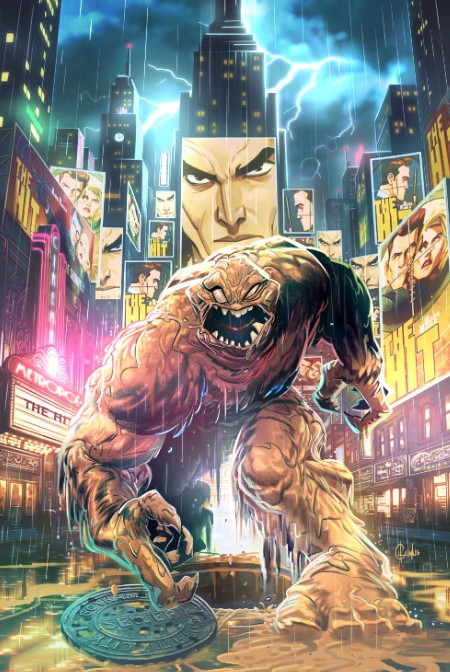
Among Batman’s rogues' gallery, few villains are as visually striking, tragic, or versatile as Clayface. While casual audiences usually envision a hulking, monstrous figure composed of living mud, the history behind the name is far richer. Clayface isn't simply one person. It is a legacy title passed down through multiple individuals in DC Comics history, each bringing a distinct flavor of body horror, theatricality, and personal tragedy to Gotham City.
The question of who Clayface really is has taken on fresh relevance with the arrival of DC Studios’ live-action Clayface film, a horror-thriller that puts the character at the center of his own story for the first time on the big screen. For viewers coming to the villain through the movie, the comics offer a surprisingly deep catalog of origins, rivalries, and reinventions worth knowing.
The Golden Age Origins: Basil Karlo
The original Clayface, Basil Karlo, debuted in Detective Comics #40 back in 1940. Unlike modern metahuman takes on the character, Karlo started out as a washed-up horror actor. When he discovered that a classic movie he starred in, The Dreaded Clayface, was being remade without him, Karlo snapped.
He adopted the identity and killer mask of the film's titular monster, targeting the cast and crew. At this point in comic history, he possessed no supernatural powers. He relied solely on theatrical disguise, stealth, and a blade. Decades later, Karlo would inject himself with blood samples from later shape-shifting villains to acquire true metahuman abilities.
It is worth pausing on the setting of that first appearance. The early 1940s were a golden era for monster pictures, and comic writers borrowed heavily from the atmosphere of screen horror. The name Basil Karlo itself nods to the great horror stars of the period, and the story of an aging performer unable to let go of his own fame gave the character a psychological hook that has never gone away. Even before he could change shape, Clayface was a villain defined by performance and obsession.
The Metahuman Evolution: Matt Hagen
Introduced in Detective Comics #298 in 1961, Matt Hagen gave the alias its signature look and power set. Hagen was a treasure hunter who came into contact with a pool of radioactive protoplasm inside a coastal cave.
The immersion fundamentally altered his biology, enabling him to reshape his body into any form, imitate human appearances, or morph his limbs into heavy blunt weaponry. Hagen set the blueprint for how the character was understood by broader pop culture, directly inspiring the acclaimed incarnation seen in Batman: The Animated Series.
The early Hagen stories leaned into the science-fiction spirit of the era. His transformation was physical and strange, and it gave artists an irresistible challenge: how do you draw a man whose face and body can become anything? The answer produced some of Batman’s most memorable visual set pieces, from sudden duplicates to arms transformed into mallets and blades. It also gave Batman, a detective first and a fighter second, a rare problem. Every person he met might be the villain wearing a borrowed face.
Passing the Mantle
As the decades progressed, writer teams expanded the moniker across several distinct characters:
- Preston Payne (Clayface III): A scientist afflicted with acromegaly who attempted to cure his condition using Matt Hagen’s DNA. The experiment backfired, turning his body into a melting substance that dissolved anyone he touched.
- Sondra Fuller (Clayface IV): Also known as Lady Clay, an operative who gained full shape-shifting capabilities alongside the power to mimic the exact powers of anyone she duplicated.
- Cassius "Clay" Payne (Clayface V): The offspring of Preston Payne and Sondra Fuller, born as a natural-born hybrid of his parents' tragic conditions.
What stands out across these successors is how little they resemble one another in tone. Payne is among the most sympathetic figures in Batman’s world, a lonely man whose condition makes physical connection deadly. Fuller treats the power as a tool for infiltration and theft. Together they show how flexible the premise is: a single idea, a body that will not hold its shape, can support horror, pathos, and crime fiction in equal measure.
How the powers work, and where they stop
The abilities attached to the name vary from character to character, but a few themes recur. The most common is malleability: the ability to stretch, flatten, harden, or reshape the body at will. Writers have used it for everything from slipping under doors to forming weapons from an arm. A second theme is imitation, the power to copy another person’s appearance, which turns Clayface into an infiltrator as much as a brawler.
Just as important are the limits. Several versions of the character have struggled to maintain a stable form, and the strain of constant change has often been written as a source of pain rather than power. In the earliest Hagen stories, the effects of the protoplasm were temporary, forcing him to return to the source, a device that gave the character a built-in weakness and a recurring motive. Later writers explored what happens when control slips, when a face cannot hold its features, or when emotion makes the body lose its shape. Those moments, more than any fight, are where the character becomes most unsettling.
For an artist, Clayface is both a gift and a puzzle. The material can be rendered as slick mud, cracked earth, or something closer to flesh, and each choice changes the tone of the story. A monster who looks like wet clay is sorrowful and strange. One who looks like melting skin is frightening. That visual flexibility is part of why filmmakers and animators keep returning to him.
Why a shape-shifter suits Batman so well
Batman’s identity is built on disguise, so it is fitting that one of his enduring enemies is a man who can wear anyone’s face. Where other villains challenge him with brute strength or elaborate schemes, Clayface challenges the foundation of what he does. A detective relies on evidence and recognition. A shape-shifter attacks both.
There is also an emotional reason the character endures. Clayface is a story about the loss of self. His many versions are defined by what they cannot hold on to: fame, appearance, physical contact, a stable sense of who they are. That tragic quality gives writers room to treat him as more than a monster, and it explains why many of the best Clayface stories end with sympathy rather than triumph.
Clayface on screen
For many viewers, the definitive screen version arrived in Batman: The Animated Series, whose two-part story "Feat of Clay" presented Matt Hagen as an actor whose career was derailed, leading him to a risky cosmetic treatment that turned his body into living clay. Voiced by Ron Perlman, the character blended pity and menace so effectively that he became the reference point for later adaptations. The episode’s focus on an actor losing his identity also tied the modern version back to the theatrical roots of Basil Karlo.
That emphasis on performance and appearance has remained one of the character’s core ideas, and it is a thread the new feature film picks up directly.
The 2026 film: what to know
DC Studios’ Clayface is described by the studio as its first-ever foray into horror. The film was directed by James Watkins, whose earlier credits include Eden Lake, The Woman in Black, and the 2025 remake of Speak No Evil. The screenplay is credited to Mike Flanagan and Hossein Amini, with Flanagan also credited for the story, and the producers include Matt Reeves, James Gunn, and Peter Safran.
Tom Rhys Harries stars as Matt Hagen, with a supporting cast that includes Naomi Ackie, David Dencik, Max Minghella, and Eddie Marsan. The official synopsis describes Hagen as a rising Hollywood star who becomes a monstrous, vengeful figure after scientific ambition strips away his identity and humanity. That premise draws on both of the character’s classic strands, the actor consumed by his career and the man transformed by science, and it leans toward body horror rather than conventional superhero spectacle.
The film’s release was scheduled for October 21, 2026 in international markets and October 23 in North America, after an earlier plan for September 11. The later date placed it in the Halloween season, a fitting window for a story built around transformation and dread.
Where to start with the character
Readers curious about the source material can begin with the two debut stories, Detective Comics #40 for Basil Karlo and Detective Comics #298 for Matt Hagen. Together they show the two foundations of the legend: the actor in a mask and the man changed by a mysterious substance. Viewers who prefer animation can start with "Feat of Clay" from Batman: The Animated Series, which remains one of the most admired treatments of the character and a compact introduction to why he has lasted.
What Makes Clayface Endure?
Beyond the raw visual appeal of a massive shape-shifting clay monster, Clayface works because the core of the character is deeply human. Beneath the layers of mud, these characters are almost always driven by vanity, lost identity, or physical agony.
Whether depicted as an actor who lost his identity to his roles or a tragic victim mutated by science gone wrong, Clayface remains one of Batman's most haunting, complex adversaries.
That adaptability is the secret of his longevity. Each generation of creators can reshape him, quite literally, to reflect its own anxieties, whether about celebrity, medical science, or the fragility of the body. The details change from era to era, yet the heart of the character remains the same: a person trying, and failing, to hold on to who they used to be.