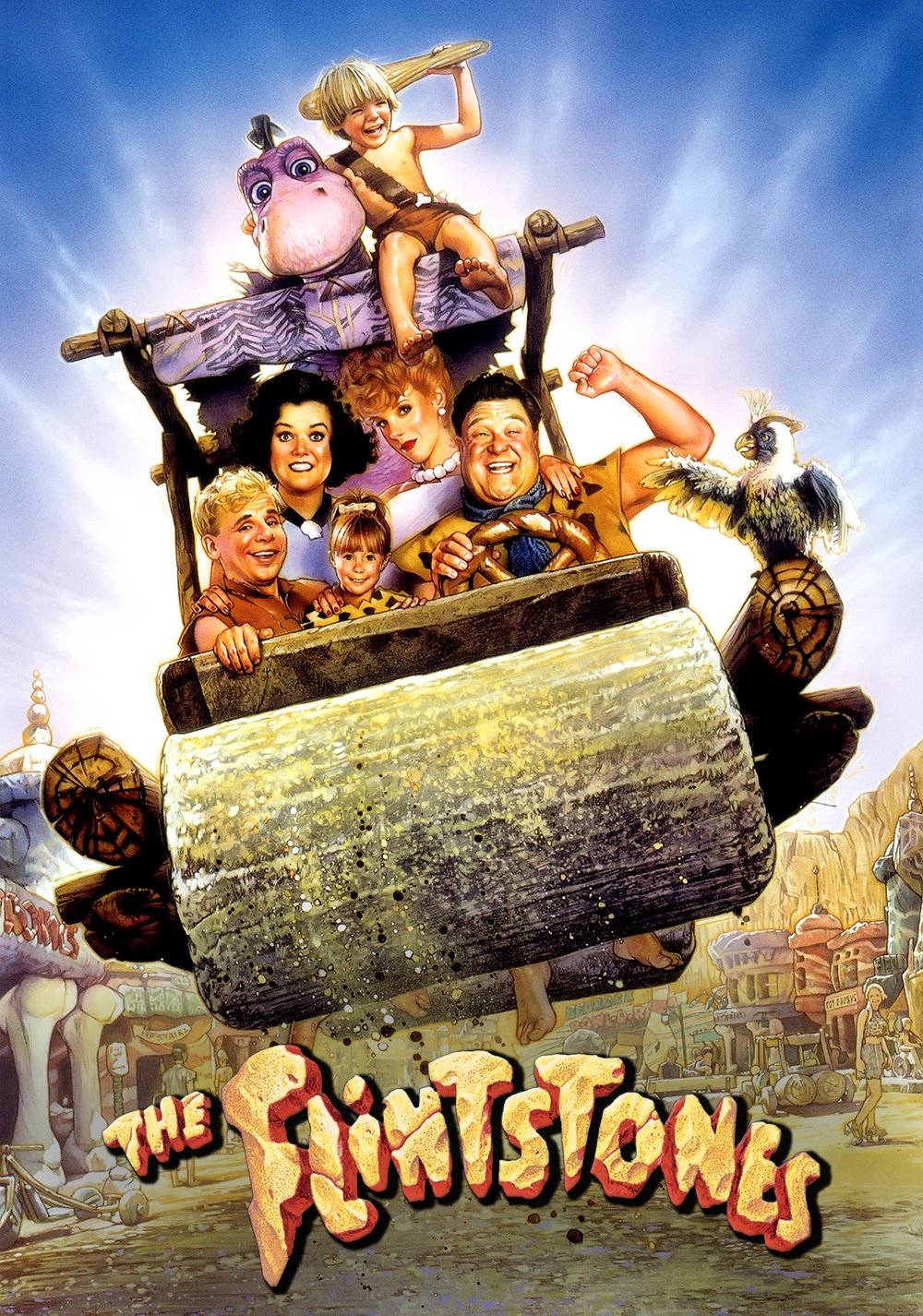
Few blockbusters of the early 1990s look as strange, or as lovingly handmade, as The Flintstones. Released on May 27, 1994, Brian Levant’s live-action version of the Hanna-Barbera cartoon arrived one year after Jurassic Park, carried Steven Spielberg’s name as an executive producer, and cost about $46 million to make. It earned almost $342 million worldwide, set a Memorial Day weekend record, and was pummeled by most critics along the way.
Three decades later, the bad reviews have faded, but the craft has not. Behind the puns and the product tie-ins sits a full-scale Stone Age town built in the California desert, a prehistoric menagerie of puppets and animatronics from Jim Henson’s Creature Shop, and a computer-effects count so small it would surprise anyone used to modern franchise filmmaking. This is the story of how The Flintstones was made, how its effects were achieved, and how a movie that critics rejected became one of the biggest hits of its year.
Nine Years in Development Hell
The road to Bedrock was long. In 1985, producers Keith Barish and Joel Silver bought the rights to make a live-action Flintstones feature, and Richard Donner was attached to direct. Steven E. de Souza delivered a script in 1987, but it was rejected. Over the next few years the project passed through a string of drafts: a version by Daniel and Joshua Goldin in 1989, another from Peter Martin Wortmann and Robert Conte in 1990, and a Mitch Markowitz script said to be inspired by The Grapes of Wrath, in which Fred and Barney leave town in a prehistoric depression to hunt for work. Donner reportedly found it too sentimental.
Eventually the rights landed at Amblin Entertainment, Spielberg’s company. By then the project had a crucial advantage: Spielberg had decided exactly who his Fred Flintstone would be. After working with John Goodman on Always in 1989, he reportedly announced at that film’s table read that he had found his Fred. From that point the movie was effectively built around one actor.
Brian Levant, the Superfan Behind the Camera
Spielberg and Kathleen Kennedy needed a director who understood the cartoon, and Brian Levant had spent his life absorbing it. A veteran of television comedy who had written for Mork & Mindy and Happy Days, Levant had moved into features with Problem Child 2 and Beethoven, both for Universal. In his pitch, he described the film as real people living in a Flintstones world, “a sitcom on steroids.”
He also brought evidence of his devotion. Levant was a serious collector of Flintstones merchandise, and he reportedly showed Spielberg a Polaroid of his collection, which at the time numbered only a few dozen pieces. Once hired, he brought vintage toys to the production so the prop and art departments could use them as references. It was a fitting choice for a film built on nostalgia: the director’s childhood toy shelf became the design bible.
A Script Written by 35 Writers
Once Levant was on board, all earlier scripts were thrown out. In May 1992, Michael J. Wilson submitted a four-page story that became the foundation for the film, and Jim Jennewein and Tom S. Parker turned it into a screenplay. Then the roundtables began. Levant gathered friends from television sitcoms such as Family Ties, Night Court and Happy Days, a group nicknamed the Flintstone Eight, and then held further sessions that brought in even more comedy writers. Lowell Ganz and Babaloo Mandel were reportedly paid $100,000 for two days of work.
In the end, roughly 35 writers contributed, with Levant making a final round of revisions before registering a shooting script on August 7, 1993. Rick Moranis later joked that it was one of those scripts with about 18 writers. The credited screenwriters are Steven E. de Souza, Jim Jennewein and Tom S. Parker, and only the bones of the story survived: Fred is set up as the patsy in an embezzlement scheme at Slate & Co. Everything else, including the film’s dense layer of rock-based wordplay, came out of those writing rooms.
That process explains much of the film’s reputation. The jokes are plentiful and the puns are relentless, but the plot reads like a committee product. Even so, the writers’ room approach was a deliberate attempt to match the pacing and gag density of a half-hour cartoon.
Casting Bedrock
Goodman was Spielberg’s first and only choice for Fred, and the studio reportedly would not have made the film without him. The actor has said he felt cornered by the announcement, and that he feared hearing “Yabba-dabba-doo” for the rest of his life. Others considered for the role included John Candy, Jim Belushi, Dan Aykroyd, Bill Murray and Chevy Chase, but several of them were judged too slim, and a fat suit was ruled out.
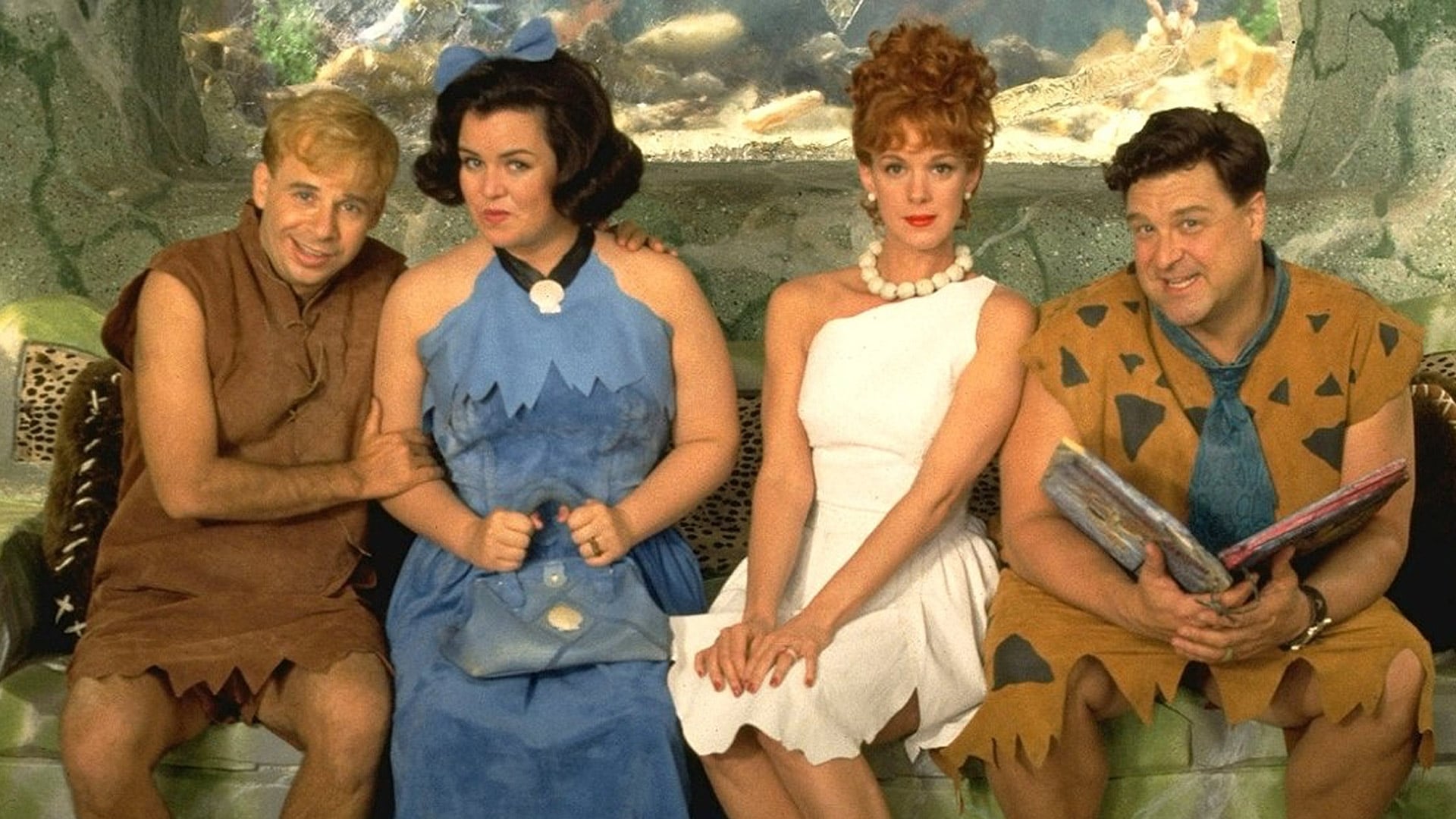
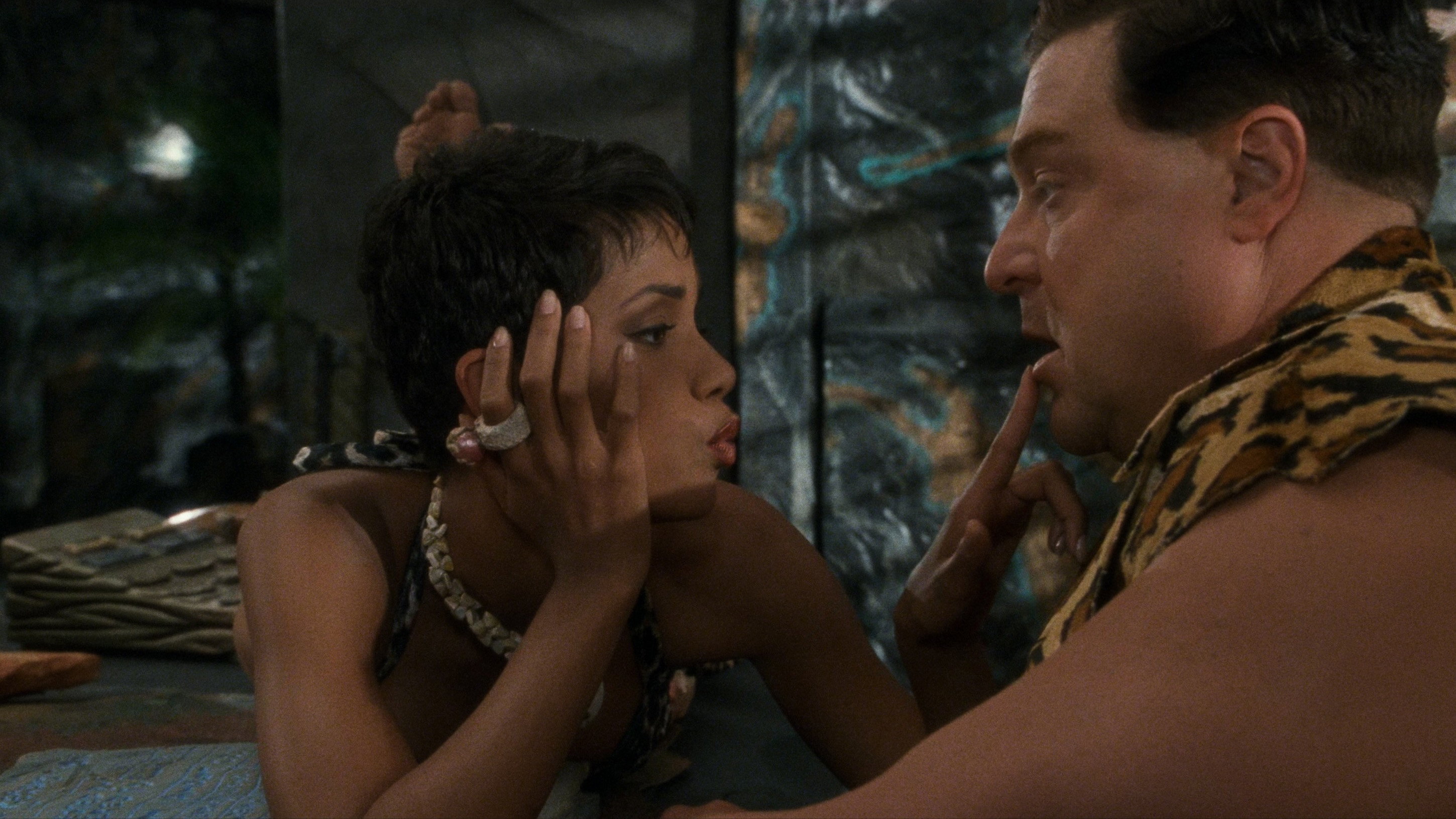
Danny DeVito was reportedly the first choice for Barney Rubble but felt his voice was too gruff, and he is said to have suggested Moranis. Rosie O’Donnell won the role of Betty after performing an impression of the cartoon character’s signature giggle, and Elizabeth Perkins became Wilma. Elizabeth Taylor played Wilma’s disapproving mother, Pearl Slaghoople, in what was her final theatrical film appearance. Kyle MacLachlan played the scheming executive Cliff Vandercave, and Halle Berry played his accomplice, Miss Sharon Stone. The name was a Spielberg joke: he had wanted the actual Sharon Stone, who passed because of scheduling.
The supporting cast was packed with cameos. The B-52’s appeared as the BC-52’s and recorded a version of the cartoon’s theme song, Harvey Korman voiced the Dictabird, Jay Leno hosted Bedrock’s Most Wanted, and original voice actress Jean Vander Pyl appeared as Mrs. Feldspar. Hanna-Barbera founders William Hanna and Joseph Barbera also turned up in cameos.
Building Bedrock: Foam, Props and Vasquez Rocks
Principal photography began on May 17, 1993, and wrapped on August 20 after three months, with locations in Los Angeles County and Utah’s Glen Canyon. The centerpiece was a full Bedrock street constructed beside Vasquez Rocks in California, the same jagged desert formation that has doubled for alien worlds and Old West badlands for decades. The set drew so many visitors that fans and industry figures flocked to see it, and it was open for tours before being demolished.
Levant has said the scale of the build is what he is proudest of. Hundreds of technicians carved huge blocks of Styrofoam to create the rounded stone buildings and housing development, and the production made more than 6,000 props, costumes, sets and vehicles, from toilet paper to the signage for Slate & Co. William Sandell and Eloy Lobato handled production design, and the look leaned into the cartoon’s bulbous, hand-hewn geometry rather than realistic rock.
Hanna and Barbera toured the Universal soundstages during construction, and Levant recalled that the creators were visibly moved. Barbera reportedly said he never expected to see anything like it. Looking back, the director has argued that a modern production would hand most of this work to computers, leaving little more than doors and floors on set.
The Practical Effects: Jim Henson’s Creature Shop
The film’s prehistoric animals were its most important practical-effects challenge. Spielberg first suggested Stan Winston, whose team had just created the dinosaurs of Jurassic Park. Levant passed, feeling Winston’s approach was too realistic for the whimsical tone of the cartoon. He turned instead to Jim Henson’s Creature Shop, the studio behind The Dark Crystal and Labyrinth, and has said the decision was influenced by how much Henson programming his own children watched.
The Creature Shop relied on the Henson Performance Control System, a rig of levers and controls that drove dozens of small servo motors, and those motors operated eyelids, mouths, lips, ears, beaks and wings. That precision allowed puppeteers to give each creature a distinct personality, which was essential for a world where animals work as household appliances.
Among the creations were the Flintstones’ hyperactive pet Dino, Fred’s talkative office Dictabird, and a parade of everyday fauna, including gadgets such as a pig-like garbage disposal that gave the film its sight gags. Empire’s contemporary review singled out the animatronics and puppets, especially Dino and the Dictabird, as the best things in the film.
The team did not get Dino right on the first attempt. The filmmakers tried to portray Dino and Babypus, the family’s saber-toothed cat, as performers in costumes, but the results did not look good enough. They redesigned Dino to match the cartoon more closely, and the final version was a puppet in close-ups and a computer-generated creature in full-body shots.
Only 53 Computer-Generated Shots
Because Levant committed so firmly to physical effects, the entire film contains only about 53 computer-generated shots, many of them devoted to Dino. Industrial Light & Magic, which had just created the digital dinosaurs for Jurassic Park, handled the digital work after Levant was impressed by what it had done for Spielberg. The crew overlap went further: Jurassic Park was still in post-production when The Flintstones started, so Levant could call on cinematographer Dean Cundey and special effects supervisor Michael Lantieri, both of whom had just helped bring Spielberg’s dinosaurs to life.
Lantieri supervised the film’s special effects on set, and Cundey photographed the oversized foam world. The combined result was covered in depth in Cinefex magazine, whose issue 58 featured the film under the title “The Making of a Rockbuster.”
Levant has said the goal was a world that honored the parameters of the cartoon while making it bigger, grander and more tactile. Rather than choose between too real and too cartoony, he aimed for a balance that audiences could accept as a place where people actually live.

Marketing a Stone Age Phenomenon
Universal and Amblin sold the film as the event movie of the summer. McDonald’s became “RocDonald’s” in commercials, brought back the McRib in a “Grand Poobah Meal,” and released a line of glass mugs and character toys. In the United Kingdom, Tetley ran its own tie-in campaign. Ocean Software produced a video game for the Game Boy in 1994 and the Super Nintendo in 1995, and MTV broadcast an episode of The Grind from the Bedrock set, with dancers in cave outfits.
The marketing worked in part because the film had arrived on the heels of Jurassic Park and promised something similar for families: new technology, famous names and a recognizable brand. It was the most heavily hyped film of the season, and a $46 million budget was unusually large for a comedy.
Box Office: A Record Memorial Day and a Global Hit
The numbers were impressive. The Flintstones took in $37.2 million over its four-day Memorial Day opening weekend in 1994, a record for the holiday at the time, beating Indiana Jones and the Last Crusade. It finished with about $130.5 million in the United States and Canada and another $211.1 million overseas, for a worldwide total of about $341.6 million, more than seven times its budget. Some trackers list a higher worldwide figure of around $358.5 million, so you may see both numbers quoted.
| Measure | Result |
|---|---|
| Budget | About $46 million |
| Opening (4-day Memorial Day) | $37.2 million |
| US and Canada | About $130.5 million |
| International | About $211.1 million |
| Worldwide | About $341.6 million |
The film held the top spot for two weeks before Speed took over. Abroad, it opened with the second-biggest weekend of the time in several markets, behind only Jurassic Park, including an $8.7 million opening week in the United Kingdom and a record four-day start in Mexico. It eventually grossed more than $35 million in Germany, $31 million in the UK and $15 million in Italy, though it struggled in France and South Korea. The Memorial Day record was broken two years later by Mission: Impossible.
What the Critics Said
If audiences loved the movie, critics did not. Rotten Tomatoes lists 23 percent positive out of 48 reviews, with an average rating of 4 out of 10, and Metacritic gives it 38 out of 100. CinemaScore audiences were kinder, giving it a B+.
Roger Ebert gave it two and a half stars out of four, praising the production design as “delightful and inventive” while complaining that the story was confusing, not very funny and odd for its young target audience. Gene Siskel was harsher, awarding one and a half stars, and the two gave the film a joint thumbs-down on their show. Kenneth Turan of the Los Angeles Times argued that the film had never had much potential and compared it to The Addams Family as a piece of showy machinery that favored spectacle over writing. Caryn James of The New York Times credited Goodman with doing much to carry a script that was largely rock jokes stretched to feature length.
“A mountain of production, a rock of a cast, and a pebble of thought.”
Not everyone was unkind. Todd McCarthy of Variety called it a fine popcorn picture for small fry and inoffensive for adults, and Richard Schickel of Time said nothing had been lost or inflated in the adaptation. Even Joseph Barbera, who admired the visuals, said in a 1997 interview that the story was not as good as he could have made it. At year’s end, the film turned up on several worst-of lists, including those of Desson Howe of The Washington Post and Peter Travers of Rolling Stone.
Awards, Razzies and Nominations
The awards season was equally lopsided. At the Golden Raspberry Awards, the film won Worst Screenplay, and Rosie O’Donnell won Worst Supporting Actress. Elizabeth Taylor received a nomination in the same category, and the film was nominated for Worst Remake or Sequel. It also drew nominations at the Stinkers Bad Movie Awards.
There was a bright spot in the sci-fi and fantasy world: the film received four Saturn Award nominations, including Best Fantasy Film and Best Costume Design, plus supporting-actress nominations for O’Donnell and Berry. That split sums up the film’s reception neatly. The writing took the blame, and the craftsmanship took the credit.
Goodman, the Sequel That Wasn’t, and Viva Rock Vegas
Universal wanted more. The studio reportedly planned two sequels to shoot back to back, in the manner of the Back to the Future follow-ups, but Goodman was not interested. Levant has guessed that years of strangers shouting the catchphrase at him in airports wore him down, and he recalled that the actor asked Spielberg not to make him do any more.
The sequel was reworked as a prequel, The Flintstones in Viva Rock Vegas, released on April 28, 2000, with an entirely new cast that included Mark Addy as Fred, Stephen Baldwin as Barney, Kristen Johnston as Wilma and Jane Krakowski as Betty. Levant returned to direct and had hoped for a full musical, but only a few numbers survived. The film earned roughly $60 million worldwide and was a clear disappointment next to the original. Levant has said the surprise was gone after so many years.
Home Video and Legacy
The film came out on VHS and LaserDisc on November 8, 1994, on DVD in 1999 and on Blu-ray in 2014. Shout! Factory released a limited-edition 4K steelbook in June 2026, a sign that the film still has a collector audience. Distribution rights remain with Universal, even though Warner Bros. Discovery controls most of the Hanna-Barbera library.
Its reputation has shifted over time. Where critics once saw a bloated, overworked adaptation, many viewers now see one of the last big-budget movies built mostly from physical materials: foam, paint, motors and puppeteers. Levant has described the shift in how the property is perceived, noting that for many younger people today the Flintstones are a brand attached to cereal and vitamins rather than a living franchise.
Why the Practical Effects Still Hold Up
The practical work is the clearest reason the film has endured. A puppet shares the frame with real actors, so the performers have something to look at, touch and react to. The sets are solid enough that actors can walk through them, lean on them and knock them over. Even the CGI is rationed so tightly that it rarely overwhelms the handmade textures.
That approach also explains the film’s look, which is closer to a live-action cartoon than to a realistic prehistoric world. Dino’s rubbery enthusiasm, the Dictabird’s wisecracks and the chunky foam buildings all follow the logic of the original designs. In an era when digital effects were quickly taking over, The Flintstones was one of the last major studio comedies to build almost everything for real.
Frequently Asked Questions About The Flintstones (1994)
How much did The Flintstones (1994) cost to make?
The budget was about $46 million, which was large for a comedy at the time.
How much money did The Flintstones make?
It earned about $341.6 million worldwide, including roughly $130.5 million in the United States and Canada. Some trackers list a higher figure of about $358.5 million.
Who made the creatures in The Flintstones?
Jim Henson’s Creature Shop built the animatronics and puppets, including Dino and the Dictabird, while Industrial Light & Magic handled the digital effects.
How many CGI shots are in The Flintstones?
According to director Brian Levant, only about 53, many of them showing Dino in full-body shots.
Where was The Flintstones filmed?
Mainly in Los Angeles County, California, with a full Bedrock set built beside Vasquez Rocks, plus some shooting in Utah’s Glen Canyon.
Did The Flintstones win any awards?
It won two Golden Raspberry Awards, for Worst Screenplay and, for Rosie O’Donnell, Worst Supporting Actress, and it received four Saturn Award nominations.
Why wasn’t there a direct sequel?
John Goodman did not want to return, so Universal made the prequel The Flintstones in Viva Rock Vegas in 2000 with a new cast.
Conclusion: A Hit Built by Hand
The Flintstones is easy to dismiss as a loud, over-written product of its time, and many critics did exactly that. But the film’s real legacy is in the details: a desert town carved from foam, a puppet dog with dozens of tiny motors in his face, and a director who treated a cartoon as a building project. Audiences showed up in huge numbers, and the movie earned more than seven times its cost.
With the 4K release and a new generation discovering it, the film’s reputation is changing from a punchline into a snapshot of the last moment when a studio comedy could build its world out of real materials. Yabba-dabba-doo, indeed.
- Wikipedia: The Flintstones (film)
- SYFY WIRE: The Flintstones at 30, Director Brian Levant on Bringing the Modern Stone Age Family into Live-Action
- Yahoo Entertainment: How The Flintstones superfan ended up directing the 1994 movie
- Empire: The Flintstones review
- RogerEbert.com: The Flintstones (1994) review
- Los Angeles Times: Movie review, The Flintstones
- The New York Times: Review/Film, The Flintstones
- Chicago Tribune: Yabba-dabba Dud
- The Numbers: The Flintstones (1994)
- Amblin Entertainment: The Flintstones
News
Latest on Every Movie Plug
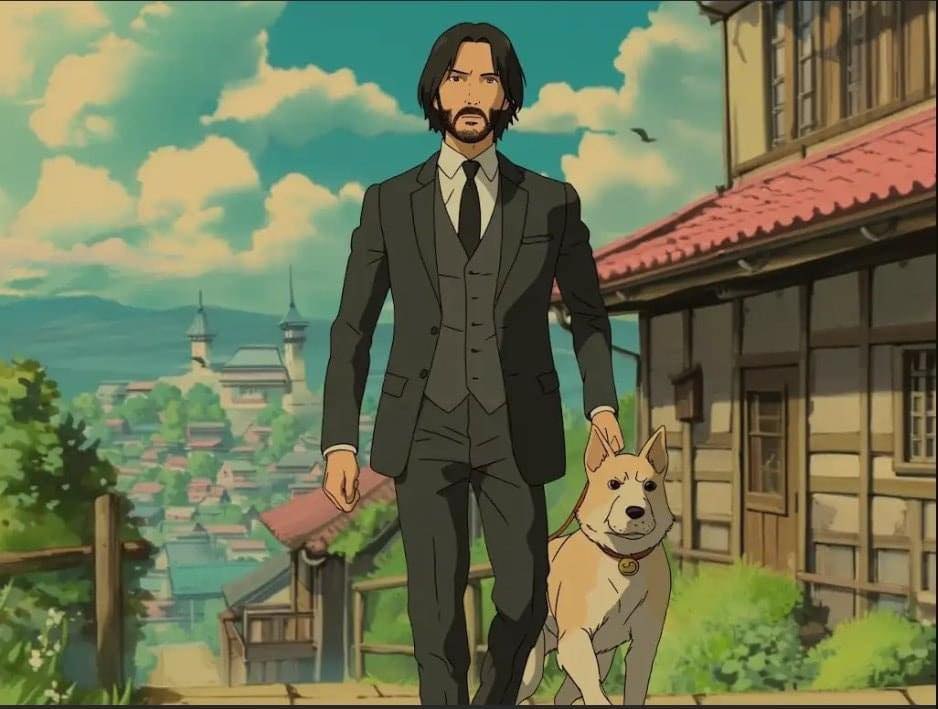 Film News Lionsgate Greenlights Animated John Wick Prequel as Keanu Reeves Signs On to Return Lionsgate has greenlit its animated John Wick prequel about the Impossible Task, with Keanu Reeves voicing the assassin and Shannon Tindle directing. Read the story →
 Film News Jeremy Allen White: The Next Wolverine? A report from Jeff Sneider says The Bear star Jeremy Allen White sat down with Marvel about a small part that could grow. Marvel has confirmed nothing. Read the story →
 Box Office News Godzilla Minus Zero Breaks Japan’s Opening-Day Record Ahead of Its North American Debut Godzilla Minus Zero earned ¥910 million on its first day in Japan, a live-action record, as the R-rated sequel opens in North America on November 6. Read the story →
Articles
More on Every Movie Plug
 Article 10 Actors Who Turned Down Roles That Became Legendary From Will Smith and The Matrix to Tom Selleck and Indiana Jones, here are 10 casting rejections that changed Hollywood history. Read the article →
 Article Five Directors, Five Visions: The Signature Styles of Hollywood’s Defining Filmmakers An examination of Steven Spielberg, Martin Scorsese, Christopher Nolan, Quentin Tarantino and James Cameron, and of what separates one great director’s wor Read the article →
 Actor Spotlight Brad Pitt Actor Spotlight: Performance, Pivots, Filmography Brad Pitt’s career, analyzed: how his performances work, the turning points from 12 Monkeys to Plan B to F1, and which films carry real weight. Read the article →