For about a century, the opening weekend has been the film industry’s pulse. Studios plan their years around it, the trades rank it by Sunday morning, and an entire class of analysts reads it the way a doctor reads a chart. On Friday, Rockstar Games and its parent company Take-Two published a number that does not fit on that chart at all: $3.79 billion in worldwide retail sales for Grand Theft Auto VI across its first day on sale, on top of a record 32.5 million copies sold before anyone had pressed start.

Rockstar called it the biggest entertainment launch in history, and the comparisons arrived right on schedule. CNN pointed out that a single day of sales had out-earned a Taylor Swift tour and an Avengers film, and that Avengers: Endgame, the highest-grossing movie ever made, needed an entire theatrical run to reach roughly $2.9 billion. Hollywood has spent years losing hours to the screens in people’s pockets, but this was a different kind of challenge. This was a rival that showed up with its own trailers, its own composers and its own premiere night, and that collected reviews from critics who kept reaching for the vocabulary of cinema.
This is not an argument that games have beaten movies, or that they have not. The two are not playing the same sport, and the sooner the box office stops pretending otherwise, the better. It is an attempt to look at what Rockstar built through the lens of film: what it inherited from the movies, what it can do that no movie can, and what the people who make films might take from the week Vice City opened.
Update (Nov 21, 2026): Day-one figures are company estimates through the end of November 19 and measure retail sales, not Take-Two’s reported revenue.
Day-one retail sales, November 19$3.79 billion
A number from a different business
Start with what the figure actually is. Rockstar’s $3.79 billion is an estimate of what players worldwide spent on the game by the end of Thursday, the day it went on sale. It is not box office, and it is not the money Take-Two will eventually book as revenue once platform fees and accounting rules are applied. A film’s worldwide gross, though, is also a gross: ticket money counted before theaters take their share. That makes the two numbers closer cousins than the usual indignant argument allows, even if they are not twins.
The differences are still large. A player who pays $79.99 for the Standard Edition, or $99.99 for the Ultimate Edition, buys software that can fill dozens of evenings. A moviegoer buys a single viewing for a fraction of the price. It is also unclear how much of the day-one total simply reflects pre-orders being counted at the moment of release. The analytics firm Sensor Tower, as reported by Deadline, put pre-order revenue alone above $2 billion before the game had even unlocked in most of the world.
How to read the record. Games and films both count consumer spending, but not the same kind. A game sale is a one-off purchase of something you can play for weeks; a ticket is one viewing. And this record is console-only, because Grand Theft Auto VI has not launched on PC.
| Title | What is measured | Figure |
|---|---|---|
| Grand Theft Auto VI (2026) | First-day retail sales, company estimate | $3.79 billion |
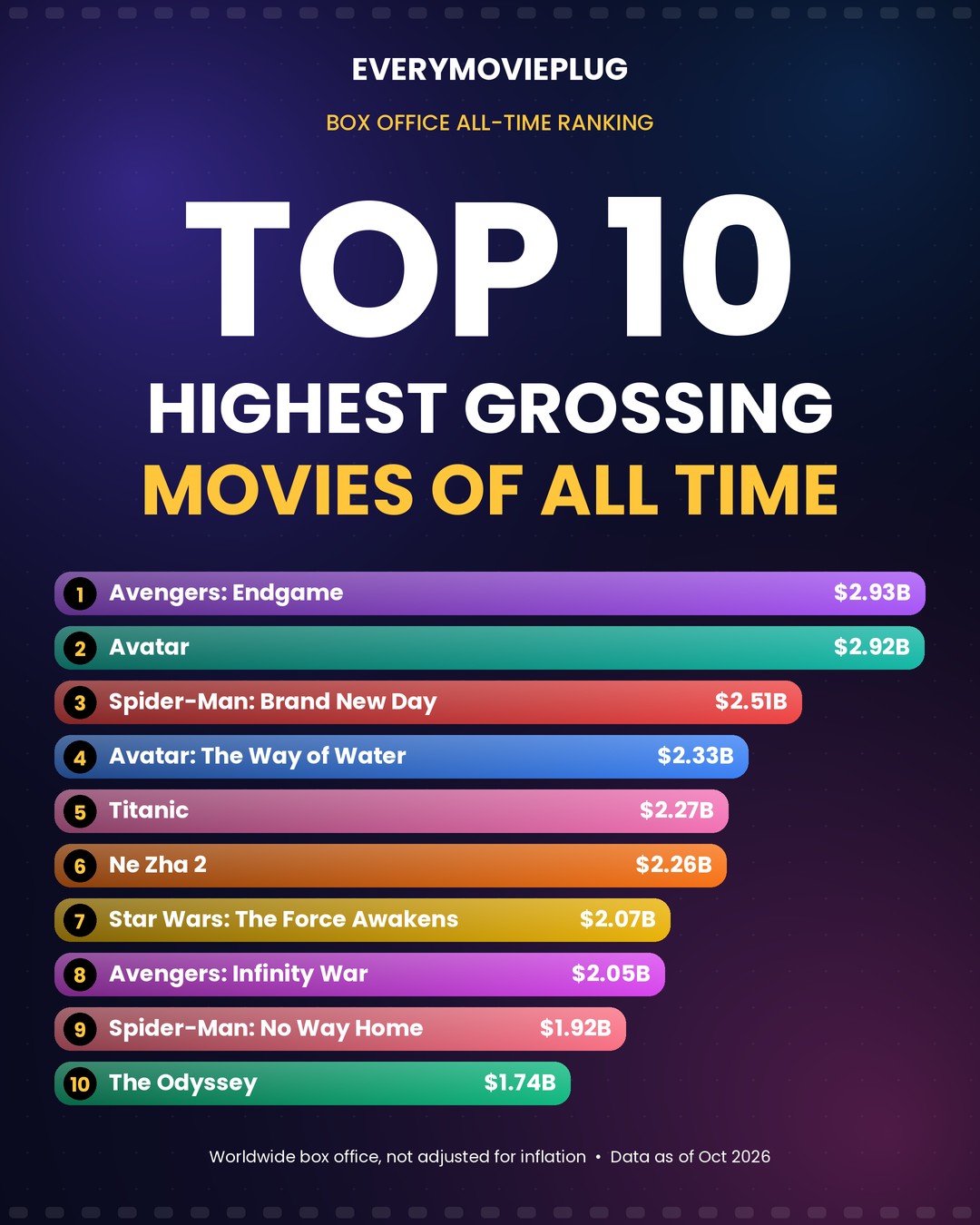
| Avengers: Endgame (2019) | Worldwide box office, full run | $2.93 billion |
| Spider-Man: Brand New Day (2026) | Worldwide box office, full run | $2.48 billion |
| Grand Theft Auto V (2013) | First-day retail sales | More than $800 million |
| The Odyssey (2026) | Worldwide box office, to date | $1.74 billion |
Film figures from our Billion-Dollar Club ranking, as of October 2026. The two kinds of figure measure different things and are shown together for scale only.
Even with those caveats, the scale is hard to wave away. Spider-Man: Brand New Day broke a record held by Avengers: Endgame with a $169.8 million opening day, the sort of result the film business spends months engineering. In raw dollars, Rockstar’s opening day was roughly twenty-two times that. The better yardstick is the franchise’s own past: when Grand Theft Auto V arrived in 2013 it took more than $800 million in its first 24 hours, which was a record then. The new game cleared that by nearly a factor of five, a gap Reuters, as relayed by Shattered, described in just those terms.
There was a second audience, too, one that never bought a copy. Stream Charts counted more than 132 million hours of Grand Theft Auto VI watched on Twitch, YouTube and Kick on launch day. A large share of the audience, in other words, consumed the game the way viewers consume a series: as spectators. That is the first sign of how blurry the border between the two media has become.
Vice City was always a movie first
Rockstar’s relationship with cinema is not a flirtation. The series found its voice in 2002 with Vice City, a game set in a pastel, cocaine-bright 1986 and widely understood as a love letter to Scarface and Miami Vice. The casting was an argument in itself. Ray Liotta played the lead, Dennis Hopper and Burt Reynolds took supporting parts, and Philip Michael Thomas, who had worn the pastel suits on Miami Vice itself, turned up as Lance Vance. Rockstar was telling players, twenty-four years ago, that it understood the film it was imitating well enough to hire its ghosts.
The new game returns to the same ground with a very different pitch. Rockstar describes Jason and Lucia as two people who have always known the deck is stacked against them, pulled into a criminal conspiracy across the state of Leonida when an easy score goes wrong.
Critics have noticed the pedigree. The tradition of the couple on the run is one of cinema’s most durable, running from Bonnie and Clyde through Badlands and True Romance, and reviewers have openly reached for that lineage when describing Jason and Lucia’s partnership. It helps that Florida has long been a genre of its own on screen: Body Heat and Scarface, Michael Mann’s Miami Vice, Out of Sight, Spring Breakers. The recipe is always the same, a thin coat of sunshine over something rotten, and Leonida, with its Keys, its port town of Port Gellhorn and its swampy interior, is built from exactly that recipe.


What a film compresses, a game lets you live through
The most interesting thing in the early reviews is not the score. It is where the praise lands. Grand Theft Auto VI has a Metacritic average of 99, a figure that ties the all-time record held by The Legend of Zelda: Ocarina of Time, and critics are largely agreeing on why. They single out the detail of the world, but above all they single out the relationship at its center, a story that several reviewers describe as more intimate than anything Rockstar has attempted outside Red Dead Redemption 2.
That is a very cinematic compliment, and it is worth taking apart. A film builds intimacy through compression. Michael Mann gives Heat 170 minutes, and in that time he can allow Al Pacino and Robert De Niro exactly one diner table, so the scene has to carry everything. Cinema’s great tool is the cut: it removes the Tuesday so that the Friday can land. A game’s great tool is the opposite. It keeps the Tuesday. According to Dot Esports’ review roundup, the campaign spends a lot of time on Jason and Lucia’s home life before the larger criminal operation begins, and while some reviewers found that opening too slow, others say those slower stretches are exactly what makes the later violence matter.
There is a subtler difference as well. Reviewers have described story missions in which scripted choices echo the way players treated the two leads in their idle moments, so the relationship the audience builds becomes part of the drama. No film can do that. A director controls the frame, the pace and the order of revelation, and that control is the whole art. A game hands some of it to the viewer, and Rockstar’s bet is that the exchange is worth the loss of authority.
Cinema lens
Grand Theft Auto VI, judged as a film
Our reading of the critical consensus, translated into film terms rather than a review of our own: a character study with a blockbuster’s scale, held back only by pacing.
Pros
- A central relationship critics keep calling the heart of the game
- A world built with a production designer’s patience
- Performances and dialogue that reviewers say reward attention
Cons
- An early stretch some critics found slow
- A running time no theater would tolerate
- An audience that has to be willing to pick up a controller
The trailer is the premiere
Hollywood has long understood that the trailer is the first screening. Rockstar understood something more specific: that scarcity is a form of marketing. The first trailer arrived on December 4, 2023, earlier than planned after a leak, and Reuters reported nearly 60 million YouTube views in its first ten hours. The second, released on May 6, 2025, introduced Jason and Lucia properly and remains the clearest statement of what the game is about.
Then came two delays, from fall 2025 to May 2026 and then to November 19. In film, a delay of that size is usually read as trouble, and it has sunk more than one franchise. Here it hardened demand instead. By launch day the game had sold 32.5 million copies in advance, and a pre-load that began on November 10 meant that most buyers were already holding the download when the clock struck midnight, region by region, starting in New Zealand. Our launch-day report walked through the rolling unlock, a premiere that traveled around the planet one time zone at a time.
The stunts went further than any film campaign would dare. The Miami Heat played a game as “A Night in Vice City” under a giant arena sign, backed by a $3.9 million deal between Miami-Dade County and Rockstar. The game took over Times Square. Today, Rockstar and PlayStation are staging Grand Theft Auto VI: The Festival in Miami’s Wynwood district. Studios have their own versions of this, and “Barbenheimer” showed what happens when audiences take over a release date, but there is a difference in kind. A studio’s stunt promotes a ticket. Rockstar’s turned an entire city into the screen.

Twenty-four frames, thirty frames, and a soundtrack
Cinema settled on 24 frames per second almost a century ago, and the flicker of that rate has become the texture we associate with film. Rockstar has said that Grand Theft Auto VI targets 30 frames per second on every current console, including the PS5 Pro, which gets sharper upscaling and ray-traced shadows instead of a faster frame rate. Thirty sits closer to the look of cinema than the 60 that many players prefer, but Rockstar has not described it as an aesthetic choice, and plenty of players see it as a limit rather than a style. It is a useful reminder that the game and the film are different machines, even when they share a visual grammar.
Where Rockstar has leaned unabashedly into cinema is sound. The company announced an original score by the French duo Justice and a 34-track companion record, Grand Theft Auto VI: The Album, released on launch day. The Launch Trailer, which arrived on October 15, introduced “Flower in a Hurricane” by Justice with Tame Impala, SZA and King Gizzard & The Lizard Wizard. A soundtrack album that is marketed as its own event is a very old movie habit, and one that has turned into a franchise-sized business for studios and streamers alike. Rockstar simply did it with a bigger budget and less shame.

Performers, not just voices
For most of the history of games, the voice in the headset was a hired hand. That has changed, and the change is easy to date. Our recent look at ten actors who gave unforgettable performances in modern AAA games traces it from Keanu Reeves in Night City to Norman Reedus on the beach, performers who lent games their faces, their voices and their movement. Rockstar has now introduced a cast of its own that includes Cal Hampton, Boobie Ike, Dre’Quan Priest, Real Dimez, Raul Bautista and Brian Heder, and Forbes, according to Vice’s review roundup, was struck by how the game’s people move and how much they have to say.
The traffic between screen and game runs in both directions. In the very week that Amazon MGM named Robert Pattinson as the next James Bond, the biggest game of the year was collecting praise for its cast’s performances. Dave Bautista, meanwhile, is bulking up for Prime Video’s God of War, and we reported on his 20-pound weight gain for Kratos. Film stars are walking into games, and game characters are walking into prestige television, and neither industry any longer pretends the borderline is clean.
The adaptation question runs both ways now
The film business’s relationship with video games has been strange for thirty years, and 2026 has been a typical year of its ups and downs. CinemaBlend’s survey notes that The Super Mario Galaxy Movie saw huge box office returns while Mortal Kombat II did more modestly, and GamesRadar says A Minecraft Movie and Five Nights at Freddy’s 2 smashed box office records last year. On television, Netflix is developing a PUBG series with Donald Glover attached, its Assassin’s Creed series is nearing the end of filming, and Bethesda has confirmed that Fallout 5 is in preproduction.
What none of those adaptations resolves is the oddity at the heart of Grand Theft Auto VI: the franchise whose style is most obviously borrowed from film has never become one. The most famous screen portrayal of the series is a drama about the people who made it, the BBC’s The Gamechangers in 2015, with Daniel Radcliffe as Sam Houser, and that was about the fight over the game rather than the story inside it. Rockstar has guarded its worlds jealously, and for good reason. A game that has just earned a 99 for being a game has little to gain from being turned into a two-hour version of itself.

A calendar owned by one release
Hollywood’s real exposure is not to this game but to what it represents. A Bank of America analyst, cited by CNN, wrote on Friday that Grand Theft Auto has now become a “multigenerational franchise” on par with James Bond, Star Wars and Mickey Mouse. That is a striking promotion for a series that spent years better known for its controversies than as a rival to film. We took the measure of two of those franchises recently in our comparison of James Bond and John Wick, and the lesson of that piece applies here: a franchise lives or dies by whether its audience believes the next installment will be worth the wait.
Cinema has reason to feel that pressure. Our look at why James Gunn’s DC Studios tenure ended is a case study in how hard it is to build a decade-long universe even when individual films make money. Rockstar’s approach is nearly the reverse: thirteen years between mainline entries, an almost fanatical control over what is shown, and a release date that feels like an appointment. A studio that feeds the same franchise to its audience every few months can teach that audience that there will always be another one next week.
None of this means the box office is doomed, and the evidence runs the other way. Spider-Man: Brand New Day has grossed $2.48 billion, The Odyssey is already the highest-grossing R-rated film ever, and on December 18 Avengers: Doomsday and Dune: Part Three open together. Our Dunesday survival guide and Marvel watch guide exist because those films, too, are events. What nobody has shown yet is that a game selling at this level takes a single ticket buyer away from a theater. That is a question for the data to answer, not for the headlines.

What cinema should take, and what it should keep
If there is a lesson for the film industry, it is not “make it longer” or “make it interactive”. It is a handful of older and more modest ideas that Rockstar happens to have executed at enormous scale.
The first is patience as a product. A film that has been in the public eye for thirteen years would be exhausted. A game that has made people wait that long has made them hungry, and the delays did not dent the pre-orders. The second is detail as respect for the audience: critics are praising Leonida less for its size than for the way it rewards attention, and that is a lesson any production designer would recognize. The third is the one reviews keep returning to. For all its technology and its marketing, the game succeeds, according to nearly every critic, because of two people and how they treat each other.
And there is what cinema should keep. A film ends. That sounds like a limitation, but it is the great luxury of the form: a story shaped, finished and handed over at the exact length its maker intended, experienced in a dark room with strangers who laugh and gasp at the same moments. A game of this size is never finished in that sense, because the player sets the pace and the world keeps going. Both are legitimate art forms, and the interesting thing about this moment is that neither is any longer embarrassed by the other.
In four weeks, the box office gets its turn to answer. Avengers: Doomsday and Dune: Part Three will open to numbers that cannot be compared directly with Rockstar’s $3.79 billion, and the people who work in film will know it. They will also know that the audience that spent last Thursday in Vice City is the same audience they are about to ask for a ticket. The smartest thing the industry can do is stop treating that as a threat, and start asking what that audience just told it.
- Rockstar Games: Grand Theft Auto VI media
- CNN: GTA VI sales blew past $3 billion in its first day, making it one of the biggest entertainment launches ever
- Deadline: GTA VI launch day sales pass $2 billion as the game takes over the zeitgeist
- Rolling Stone: GTA VI sets new record with nearly $4 billion in sales on launch day
- Digital Trends: GTA VI just outsold every movie, album and game launch ever
- Shattered: GTA VI’s $3.79B is retail sales, not Take-Two revenue
- The Next Web: GTA VI ties Metacritic’s all-time record with a 99 as it launches
- Dot Esports: GTA 6 review roundup
- Vice: GTA 6 review roundup
- Reuters via Investing.com: Rockstar Games sets GTA VI launch for 2025 in game’s first trailer
- Take-Two Interactive: Second-quarter fiscal 2027 results
- CinemaBlend: Upcoming video game movies and TV shows
- GamesRadar: Every upcoming video game movie you need to know about in 2026 and beyond
- Every Movie Plug: The Billion-Dollar Club
- Every Movie Plug: GTA VI Is Live: Vice City Opens, One Time Zone at a Time
News
More on Every Movie Plug
 Gaming News GTA VI Is Live: Vice City Opens, One Time Zone at a Time Grand Theft Auto VI is live on PS5 and Xbox Series X|S, unlocking at midnight local time and starting in New Zealand. Here is what is out now. Read the story →
 TV News Donald Glover to Star in, Write and Direct Netflix’s Live-Action PUBG Series Netflix and Krafton are developing a live-action PUBG series with Donald Glover attached to star, write, direct and executive produce alongside his brother Stephen. Read the story →
 TV News Dave Bautista Shows Off 20-Pound Weight Gain on Instagram as Kratos Prep Hits 250 Dave Bautista posted an Instagram story saying he has gained 20 pounds for Prime Video’s God of War and now weighs 250. Here is where his transformation began and what happens next. Read the story →
Articles
More on Every Movie Plug
 Gaming 10 Actors Who Gave Unforgettable Performances in Modern AAA Games From Keanu Reeves in Night City to Norman Reedus on the beach, ten screen actors who brought their faces, voices and motion capture to the biggest games since 2013. Read the article →
 Article The Billion-Dollar Club: The 10 Highest-Grossing Movies of All Time Worldwide box office, unadjusted for inflation, as of October 2026. Totals include rereleases, and several films are still earning. Read the article →