Spoiler warning
This article discusses the endings of No Time to Die and John Wick: Chapter 4.
Two franchises built on men who kill for a living are heading into the same stretch of the decade from opposite directions. James Bond has just found its seventh actor after the longest and most public search in its history. John Wick has lost the one thing a franchise is supposed to protect, its lead character, and is trying to keep growing anyway. One is a 64-year-old institution that changed owners. The other is a 12-year-old upstart that turned a modest revenge thriller into a billion-dollar universe.
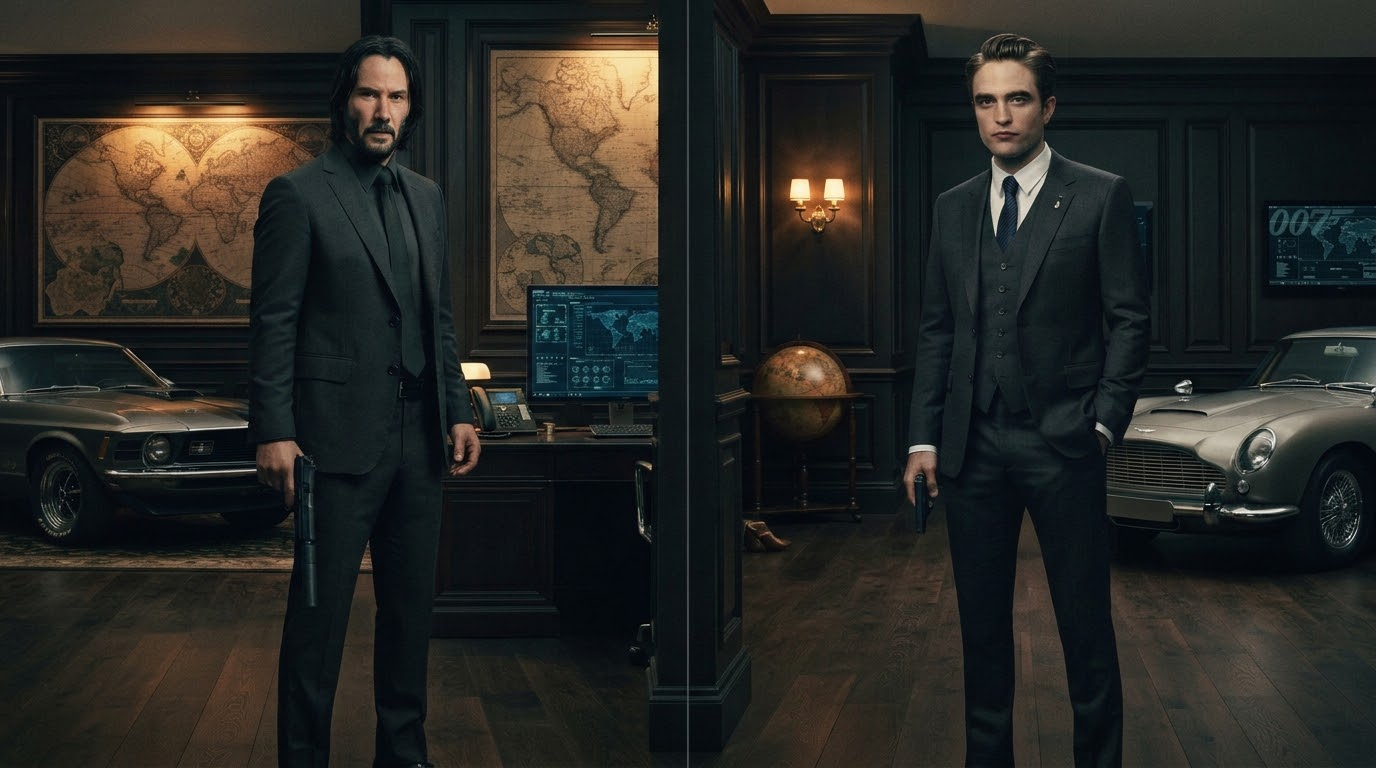
Comparing them is more than a fan game. Both series sell the same promise, which is precise, stylish violence delivered by a man who is better at his job than everyone else in the room. Yet in recent years they have answered the same hard questions in very different ways: what to do when the star leaves, how to expand a universe without diluting it, and how much a franchise can lean on spectacle before it needs a story.
The short version: Bond has the bigger brand, the bigger budgets and a fresh start under Denis Villeneuve, but every film since 2006 starred Daniel Craig, and it is now starting from zero. Wick has the tighter creative identity and better returns on its biggest hits, but its spin-offs have not yet proved the world can stand without Keanu Reeves. Bond’s problem is reinvention. Wick’s problem is succession.
Where the two franchises stand today
On November 16, 2026, Amazon MGM Studios announced that Robert Pattinson will play 007 in the 26th Bond film, directed by Denis Villeneuve. Every Movie Plug covered the announcement in Robert Pattinson Is the New James Bond, Amazon MGM Announces, and the details matter for this comparison. Pattinson becomes the seventh actor to play Bond in the main series, Steven Knight is writing the script, and Amy Pascal and David Heyman are producing. There is no release date, no title and no start date for shooting, though reports have pointed to a 2028 target.
Update (Nov 16, 2026): Amazon MGM confirmed Robert Pattinson as the next James Bond. Trade reports say he reached the final round alongside Callum Turner, Jack Lowden, Josh O’Connor and Nicholas Hoult, and that he is reportedly signed for multiple films. Amazon has not confirmed the number.
The Wick side of the ledger is quieter. There is no John Wick film in cinemas in 2026. The next release is Caine, the spin-off starring and directed by Donnie Yen, which wrapped production in July and is expected in 2027 without an official date. A fifth mainline film was announced at CinemaCon in 2025 with Keanu Reeves and Chad Stahelski attached, but it has no script milestone to point to. On November 5, Lionsgate also confirmed an animated prequel about the Impossible Task, which Every Movie Plug reported in Lionsgate Greenlights Animated John Wick Prequel as Keanu Reeves Signs On to Return.
Two very different kinds of franchise
The first thing to understand is that these are not the same kind of property, and comparing raw numbers without that context misleads.
Bond is a character who was designed to be replaced. Since Dr. No in 1962, the series has treated the lead as a role, not a person. Connery, Lazenby, Moore, Dalton, Brosnan and Craig each reshaped the character, and the franchise survived every change. Its identity lives in the formula: the cold open, the gadgets, the exotic locations, the theme song and the villain with a plan. Casting a new Bond is a ritual, and the character outlives any single interpretation.
John Wick is the opposite. It is a character-first series built around one performance, one visual language and one director’s idea of how action should look. Reeves is not a replaceable lead in the way that Craig was. He is the reason the first film worked, and Stahelski, who directed all four chapters, is the reason the later ones kept escalating. The world of hotels, coins, markers and the High Table is rich, but it was invented to give Wick something to fight against.
That structural difference explains almost everything that follows. Bond can survive a reboot because the brand is bigger than the man. Wick can survive only if the world is strong enough to carry stories about other people, which is exactly what its spin-offs are now testing.
The box office story
The numbers are the clearest place to begin, because they tell opposite stories about scale and momentum.
| Bond film | Year | Worldwide gross (approx.) |
|---|---|---|
| Casino Royale | 2006 | $600 million |
| Quantum of Solace | 2008 | $590 million |
| Skyfall | 2012 | $1.1 billion |
| Spectre | 2015 | $880.7 million |
| No Time to Die | 2021 | $774 million |
| John Wick film | Year | Worldwide gross (approx.) |
|---|---|---|
| John Wick | 2014 | $86 million |
| John Wick: Chapter 2 | 2017 | $172 million |
| John Wick: Chapter 3 – Parabellum | 2019 | $327 million |
| John Wick: Chapter 4 | 2023 | $440 million |
| Ballerina | 2025 | $140 million |
Figures are approximate worldwide totals from public box office trackers and are rounded. Sources: The Numbers, Screen Daily and Every Movie Plug’s own coverage.
Bond’s peak is far higher. Skyfall crossed $1.1 billion, a total that no Wick film has come close to. But Bond’s trend line has bent downward since that peak. Spectre earned $880.7 million, and Every Movie Plug’s anniversary piece, Today in Cinema, November 6: Spectre Opens in America in 2015, notes that its American opening was about $20 million below Skyfall’s despite the widest release a Bond film had ever had. No Time to Die then arrived in 2021 after pandemic delays and finished at roughly $774 million, a strong result for that moment but a long way from the high-water mark.
Wick’s trend line did the reverse for four straight films. Each of the first four chapters outgrossed the one before it, a streak that is rare for any action series. Chapter 4 opened to $73.8 million in North America and finished near $440 million worldwide on a reported $100 million budget. That is a return of more than four times its production cost before marketing, which is a healthier ratio than No Time to Die managed on a reported budget that ran to well over $250 million.
Then came Ballerina. Released in June 2025 with Ana de Armas in the lead and Reeves in a supporting role, it cost around $90 million and opened to about $24.5 million in North America. It finished near $140 million worldwide, behind both Chapter 2 and Chapter 3. The same film that proved the Wick universe had room for other characters also proved that audiences do not show up for the High Table alone.
Worldwide gross$1.1 billion vs $440 million
The cleanest reading is this. Bond still has an enormous ceiling, but it has not hit it in over a decade. Wick has a lower ceiling and, so far, a better record of reaching it, except where Reeves was missing from the poster.
The star problem
Both franchises ended their most recent leading-man chapters with the character’s death, which is a remarkable coincidence and a useful one for comparison.
Ending spoilers for both franchises
No Time to Die closed the Craig era in 2021 by killing Bond, the first time in the series’ history that a film ended with the hero dead. John Wick: Chapter 4 did the same in 2023, ending with Wick dying at Sacré-Cœur after surviving a duel with the Marquis. Both films were written as full stops, and both studios now have to work around them.
The two studios responded in opposite ways. Amazon, which controls Bond, chose to start over. A new actor, a new director, a new writer and an explicitly fresh approach means the Craig continuity can be set aside. Villeneuve has said publicly that he wants to honor the legacy, and his description of the new actor as having “the timeless soul of 007” and a spirit “completely new” signals a reset rather than a sequel.
Lionsgate, which controls Wick, cannot reset in the same way because there is no second actor who can play John Wick. Reeves and Stahelski have said they will only make another mainline film if they find an idea worth telling, and Stahelski has called the problem of continuing after the ending “a bit of a conundrum.” That is a candid admission, and it is why the franchise has moved toward prequels and side stories. The animated film set before the original movie and the Caine spin-off are both ways to keep the world alive without undoing the ending.
“I am overjoyed to welcome Robert Pattinson as our new James Bond. He has the timeless soul of 007 and brings a spirit that is completely new.”
There is a case that Bond has the easier problem. A new face in a tuxedo is something the series has done six times. The harder task is finding the right face, and the long search was a sign of how seriously Amazon took it. Every Movie Plug followed the process from the first rumors in Who Will Be the Next James Bond? Casting Reportedly Narrows to a Short List to the screen-test report in Robert Pattinson Reportedly Screen-Tested for James Bond as the 007 Casting Race Tightens. By the time the official announcement came, the process had been running for more than a year.
What Pattinson and Villeneuve bring
The casting is a statement about tone. Pattinson spent two decades steering away from easy roles, working with directors like Robert Eggers, the Safdie brothers and Christopher Nolan before becoming Matt Reeves’s Batman. He is 40, which is older than the late-20s-to-early-30s actor early reports said Amazon wanted, and he is British, a point Pierce Brosnan has said is essential for the role.
Villeneuve is the larger signal. He has made some of the most ambitious large-scale films of the last decade and has a reputation for patient, immersive filmmaking. Pattinson is already part of his world: the two worked together on Dune: Part Three, which opens December 18 and which Every Movie Plug covers in its Dunesday survival guide. Audiences will also see Pattinson in Netflix’s heist thriller The Take on January 15, a project Every Movie Plug previewed in Netflix Unveils The Take First Look With Denzel Washington and Robert Pattinson.
That makes the Bond relaunch feel like an auteur-led event more than a franchise handover. The risk is the usual one: a director with a strong sensibility may deliver a Bond film that is magnificent to look at and slow to move. The Craig era taught audiences to accept gravity and consequence, and Villeneuve’s instincts point the same way. Whether that suits a character who is supposed to be fun is the central open question.
Wick has the opposite story. Stahelski came out of the stunt world and has directed every chapter, which gave the series a single hand on the wheel. The new chapter of the franchise is moving away from that. Donnie Yen is directing Caine, Len Wiseman directed Ballerina and Shannon Tindle is directing the animated prequel. Each is a talented filmmaker, but the unified voice that defined the first four films is now shared.
How they handle action
Action is where the comparison is most obviously fair, because both franchises have built their reputations on it.
Bond has historically treated action as travel. The set piece is a place: a crane chase in Madagascar, a train fight in Istanbul, a rooftop helicopter brawl above Mexico City. As Today in Cinema notes about Spectre, that film’s opening was built from six shots stitched into one long take across a real Day of the Dead procession. The franchise’s craft is in logistics, scale and location, and it has been a showcase for real stunt work since long before computer effects arrived. Every Movie Plug’s 20 Movies That Were Almost Impossible to Film shows how much of that tradition still defines ambitious filmmaking.
Wick treats action as choreography. The fights are long, readable and built around a clear logic: a man who trains constantly, reloads at the right moment and uses whatever is in the room. Its influences, which Stahelski has described openly, include Hong Kong cinema, anime and the westerns of Charles Bronson and Lee Marvin. The camera stays wide enough for the audience to follow every move, which is a style that many imitators have copied and few have matched.
The two approaches can be summarized simply:
- Bond sells the world around the fight: the car, the location, the tuxedo and the escape.
- Wick sells the fight itself: the gun work, the grappling and the sustained, continuous take.
- Bond uses violence as punctuation between scenes of intrigue.
- Wick uses story as a pretext for the next sequence of violence.
Neither is superior. Bond’s approach gives it range, from comedy to melancholy, but can feel diffuse. Wick’s approach gives it focus and a clear brand, but has a narrower emotional register and a tendency to repeat itself, which some viewers felt by the time Chapter 4 reached its nearly three-hour runtime.
Worldbuilding and universe strategy
Wick built its universe on purpose and fast. The High Table, the Continental hotels, the gold coins and the rules about which places are neutral ground gave the series a mythology that could support other stories. That is why Lionsgate has been able to expand it to a streaming series, a spin-off film and a video game, and why it now has an animated prequel and a second television series reportedly in the works. The animated film about the Impossible Task is a natural fit, because it dramatizes a piece of backstory the live-action films have only described.
Bond’s universe is looser. Its constants are MI6, Q Branch, M and Moneypenny, and the recurring organizations from Spectre to Quantum. The Craig films tried to connect them into a single arc, which Spectre attempted by recasting the earlier villains as parts of one conspiracy. As Every Movie Plug’s anniversary coverage explains, that decision was controversial, and its reception shaped how the franchise approached the next chapter. Bond works best as a series of standalone adventures, and its attempt to behave like a serialized universe was one of the least successful experiments of the era.
Amazon now faces a different question: whether to build Bond into a shared universe at all. Having acquired MGM for $8.45 billion in 2022, the company has an obvious incentive to extend the brand into television and streaming. The risk is a version of what happened to other legacy properties. Every Movie Plug’s Behind the Cape: Why DC Struggled to Match Marvel’s Cinematic Empire argues that rushed planning and corporate meddling can damage a franchise faster than any single bad film. A Bond universe could be a success, but it would have to be built more patiently than Wick’s.
The ownership question
The biggest difference between the two franchises is who is in charge.
Bond spent almost its entire life under the control of one family. Michael G. Wilson and Barbara Broccoli ran Eon Productions and oversaw every Bond film from GoldenEye onward, a continuity that gave the series stability and a unique sense of stewardship. In February 2025, Amazon took creative control through a joint venture, with the producers remaining co-owners but stepping back from decisions. Pascal and Heyman then took over production.
Wick, by contrast, has been run by the same small group since the beginning. Thunder Road’s Basil Iwanyk and Erica Lee, Stahelski’s 87Eleven and Reeves himself have steered the series through every phase, with Lionsgate as the studio. That continuity is the single biggest reason the first four films felt so coherent.
Both models have strengths. The family-run Bond era produced the series’ most durable and most stable period, and its reinventions have often been its best moments. Every Movie Plug’s How GoldenEye Saved James Bond shows how Broccoli and director Martin Campbell rescued the series after a six-year gap by making Bond’s potential irrelevance the theme of the film. That is the same kind of creative confidence Amazon needs now.
The five-year gap since No Time to Die is already long, and a 2028 release would stretch it to seven years, longer than the break that preceded GoldenEye. Meanwhile, Wick’s gap is a little over three years since Chapter 4, but its next mainline entry has no date at all. Neither franchise is in crisis, but both are in an uncomfortable middle period.
The waitFive years since No Time to Die
Spin-offs and the test of the next generation
The most interesting contrast of the next two years will be how each franchise tests its ability to move beyond its lead.
For Wick, the test is already underway. Ballerina delivered a mixed result: a film that leaned heavily on the franchise’s world and style, but a box office that fell well short of the main series. Caine is the next experiment, and it is a more focused one. Yen is a major action star in his own right, the character was a standout in Chapter 4, and Stahelski has described the film as an ode to kung fu cinema, one that does not feature Wick. The cast includes Rina Sawayama, Mason Thames and Dacre Montgomery. If Caine succeeds, it proves the universe can carry a lead other than Reeves. If it struggles, the case for the animated prequel and the fifth film becomes more urgent.
For Bond, the test comes later and is different in kind. Pattinson’s first film is the whole experiment. Unlike Wick, Bond does not need to prove its world can survive without its star, because that has been shown six times. It needs to prove that a new studio, director and actor can make a film that feels like Bond and not like a prestige drama wearing a Bond costume. That is a creative question, not a structural one.
It also means the franchises have very different risk profiles. If Wick’s spin-offs fail, the series shrinks. If Bond’s reboot fails, the studio will have spent hundreds of millions on a flop, but the brand will still be there. Bond’s strength is its resilience. Wick’s strength is its precision.
Culture, tone and the audience
Tone is the quietest difference and perhaps the most important.
Bond has always been about aspiration. The suits, the cars, the locations and the ease with which the hero moves through a room are what audiences are buying. Even in the Craig era, which stripped away much of the glamour, the franchise leaned on that fantasy. Pattinson, an actor best known for brooding, interior performances, may push the series toward something colder.
Wick is about obsession. The hero has a single motive, grief, and a single method, violence. Its appeal is that of a well-made machine: every beat is deliberate, every location is designed and every fight has a rhythm. It is also, perhaps, the more modern franchise in one way. It trusts the audience to enjoy style for its own sake, without a layer of irony, and it has built a devoted global audience on that trust.
Reeves himself is part of the appeal. His persona, quiet, decent and a little melancholic, is baked into the character. Every Movie Plug’s list of 10 Actors Who Gave Unforgettable Performances in Modern AAA Games includes his work in Night City, a reminder that his cultural footprint extends well beyond a single franchise.
For Pattinson, the equivalent quality is harder to name. His strength is his unpredictability, and the most interesting thing Villeneuve can do is use it.
Which franchise is healthier?
The honest answer depends on what you measure.
On brand strength, Bond wins easily. Its characters, music and imagery are recognized almost everywhere, and the announcement of a new actor generated a global news cycle, from royal-family social media posts to front pages. No other action franchise can command that attention.
On recent creative consistency, Wick has the edge. Its four main films form a coherent, escalating arc, and each one grew the audience. Bond’s last decade included a divisive entry in Spectre and a pandemic-delayed finale.
On future clarity, neither is comfortable. Bond has a plan but no date. Wick has a pipeline but no lead.
On financial discipline, Wick looks better. Its biggest hit returned more than four times its budget, while Bond’s recent films have cost far more for lower multiples. That may change under Amazon, which can afford to spend and has a streaming platform to feed.
Franchise outlook
James Bond
The bigger brand and the bigger reset, with a strong creative team and one enormous question about tone.
Pros
- Villeneuve directing
- Pattinson as a distinctive lead
- Amazon’s resources
- A global brand that no rival can match
Cons
- No release date
- A long gap since the last film
- Risk of a slow, self-serious tone
- Corporate ownership is still unproven
Franchise outlook
John Wick
A tight, confident universe that still needs to prove it can thrive without its star.
Pros
- A consistent creative vision
- Strong returns on the main films
- A rich, expandable world
- Caine, the animated prequel and a game keep it active
Cons
- Ballerina underperformed
- John Wick 5 is undated
- Reeves cannot be replaced
- The unified voice of the early films is now shared
What to watch next
Several events over the next two years will settle much of this debate.
- Bond 26 casting and dates. The leading roles of M, Q, the main villain and the lead female role are still open, and Amazon has yet to set a start date or title.
- Caine’s release window. A 2027 date would show Lionsgate’s confidence, and its box office will be the first real test of a Wick film without Reeves in the main role.
- The John Wick 5 script. Stahelski has said they will move forward only with a 50-page treatment they believe in, so any official development news will be a sign of real momentum.
- The animated prequel’s format. Whether it gets a wide theatrical release or goes to streaming will show how large Lionsgate thinks the audience is.
- Reception to the Dune and Take releases. Pattinson’s December and January releases will shape the conversation about him before his Bond debut. For the broader 2027 calendar, see Every Movie Plug’s Most Anticipated Movies of 2027.
For anyone building a long-term view of the big blockbuster brands, the Billion-Dollar Club is a useful reminder of how rare it is for any franchise to reach that level, and Bond has done it more than once.
The bottom line
Bond and Wick are both facing the same basic challenge: how to keep a successful formula alive after the thing that made it work has changed. Bond has a bigger machine, more money and a director who can reinvent the series, but it has not delivered a film in five years and will not for several more. Wick has a more disciplined creative identity and a better recent track record, but it is relying on spin-offs and animation to bridge a gap that only Reeves can close.
If you want a prediction, the stronger long-term bet is Bond, simply because a brand that has survived six leading men can survive a seventh. The stronger short-term bet is Wick, because Caine and the animated prequel will arrive before any new Bond film. The more interesting question is what happens when they finally compete again, with a new 007 and a continuing Wick universe fighting for the same audience.
For now, the answer is that both franchises are doing what the best action series always do: trying to stay one step ahead of the audience. Which one stays ahead longer will depend on whether it can find the next great idea before its current one runs out.
- Deadline: Amazon MGM Studios Taps Robert Pattinson To Play Next 007
- The Hollywood Reporter: James Bond Found: Robert Pattinson to Play 007
- CNBC: Robert Pattinson cast as next James Bond
- Gizmodo: Robert Pattinson Cast as James Bond
- Deadline: John Wick Spinoff Caine Gearing Up Production Under Donnie Yen
- CBR: John Wick Spinoff Caine Wraps Filming
- Collider: The Next John Wick Movie Sets the Stage for 2027 Release
- SuperHeroHype: John Wick 5 Isn’t a Sure Thing, Keanu Reeves Not in Caine Spin-off
- Screen Daily: Ballerina launches with soft $51m at global box office
- The Numbers: Box Office History for John Wick Movies
News
Latest on Bond and John Wick
 Film News Robert Pattinson Is the New James Bond, Amazon MGM Announces Amazon MGM Studios has named Robert Pattinson as the next James Bond, with Denis Villeneuve directing. What was announced, what it means and what is still unknown. Read the story →
 Casting News Robert Pattinson Reportedly Screen-Tested for James Bond as the 007 Casting Race Tightens Robert Pattinson reportedly screen-tested for James Bond in London, joining Callum Turner, Jack Lowden and Josh O’Connor in Amazon MGM’s 007 search. Read the story →
 Film News Who Will Be the Next James Bond? Casting Reportedly Narrows to a Short List Reports name Jack Lowden, Jacob Elordi, Callum Turner and Josh O’Connor among the actors in the running for James Bond, with final screen tests reportedly set for the coming week. Read the story →
 Film News Lionsgate Greenlights Animated John Wick Prequel as Keanu Reeves Signs On to Return Lionsgate has greenlit its animated John Wick prequel about the Impossible Task, with Keanu Reeves voicing the assassin and Shannon Tindle directing. Read the story →
Articles
More From Every Movie Plug
 Article How GoldenEye Saved James Bond How Pierce Brosnan’s 1995 debut in GoldenEye modernized 007, shattered franchise box office records, and proved James Bond was not a relic of the Cold War. Read the article →
 Today In Cinema Today in Cinema, November 6: Spectre Opens in America in 2015 and Takes Bond From Mexico City to a Sahara Crater Eleven years after Spectre opened in the US, how Bond 24 revived Blofeld, filmed a Mexico City parade that did not exist and won an Oscar for its theme song. Read the article →
 Article Dunesday Survival Guide: How to Watch Dune: Part Three and Avengers: Doomsday, and Which to See First Dune: Part Three and Avengers: Doomsday both open December 18, 2026. Runtimes, IMAX and premium formats, tickets, and which film to watch first. Read the article →
 Article Behind the Cape: Why DC Struggled to Match Marvel’s Cinematic Empire DC owns Superman, Batman and Wonder Woman, yet Marvel built the bigger movie empire. Here is how rushed planning, studio meddling and tone shaped the gap, and where the reboot stands now. Read the article →