The Devil’s Advocate ends with a smirk. After two and a half hours of temptation, suicide, rewound time and a Manhattan law firm that turns out to be a branch office of Hell, the camera finds a reporter named Larry walking away from a courthouse, and he turns into Al Pacino. Satan looks into the lens and says that vanity is definitely his favorite sin.
It is the most honest line in the movie, and the film around it has been paying that sin’s rent ever since. The Devil’s Advocate opened in the United States on October 17, 1997, a month before this date on the calendar, so this entry looks back at it in its 29th year rather than on its anniversary. It cost $57 million, earned about $153 million, won the Saturn Award for Best Horror Film and ended up the fifth most-rented film in America in 1998. Critics at the time called it everything from preposterously entertaining to a lawyer joke. Almost three decades on, it plays as the clearest case study of what happens when a movie star, a legend and a studio agree to go too far on purpose.
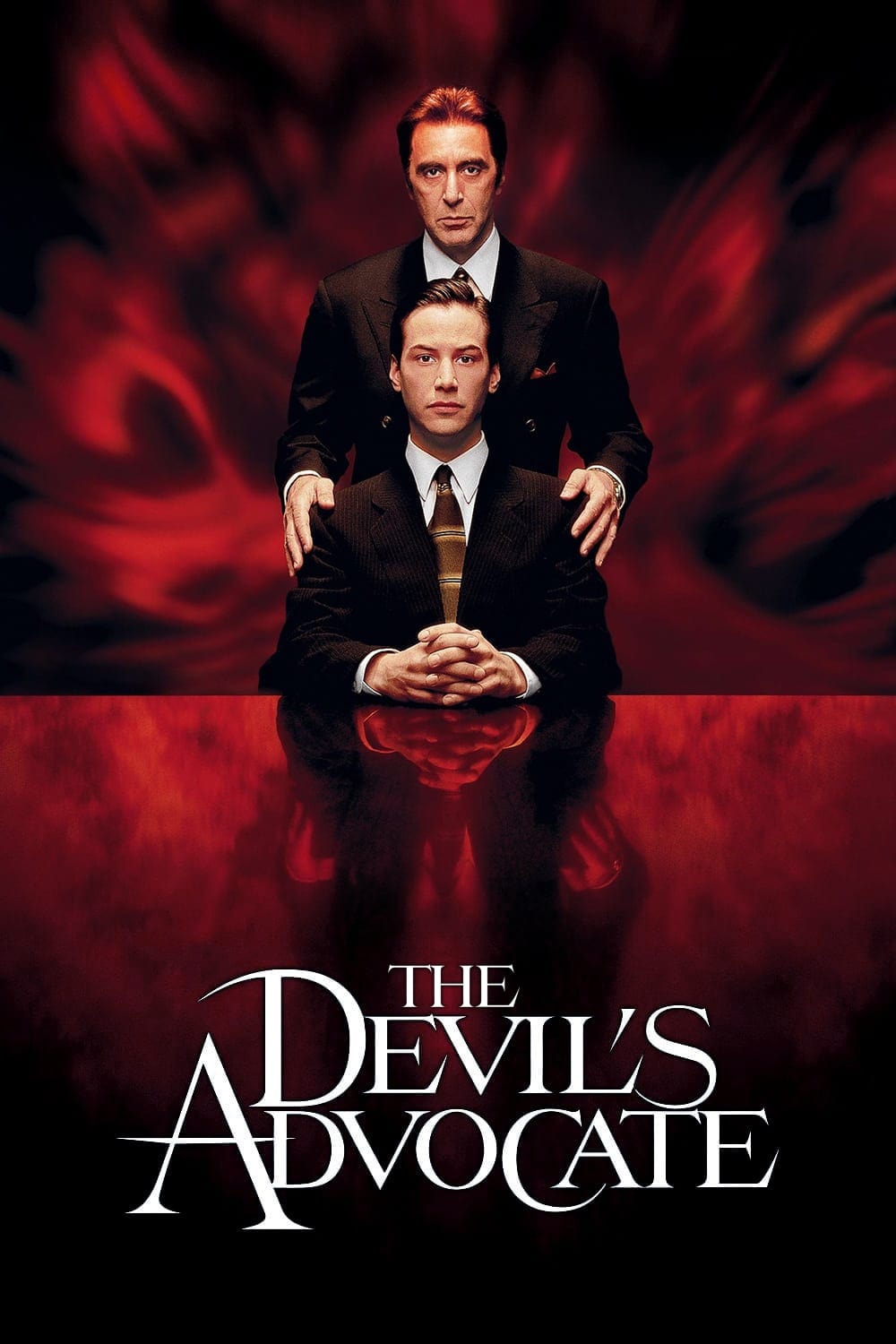
The article discusses the whole story, including the ending, so spoilers follow.
The Charge: A Lawyer Who Has Never Lost
Kevin Lomax (Keanu Reeves) is a defense attorney in Gainesville, Florida, with a perfect record. His latest client is a schoolteacher accused of child molestation. Midway through the trial, Kevin realizes the man is guilty, and he wins the case anyway by destroying the victim’s credibility on the stand. That scene is the film’s real opening argument: Kevin chooses his own damnation before anyone has tempted him.
A New York firm then recruits him to help with jury selection, and its founder, John Milton (Al Pacino), offers him a job. Kevin and his wife, Mary Ann (Charlize Theron), move to Manhattan. He is soon working long hours on the defense of a billionaire accused of murdering his wife, his stepson and a maid, while Mary Ann, alone in a new city, begins to see demonic faces and dreams of a baby playing with her removed ovaries. The firm’s managing partner, Eddie Barzoon, threatens to expose the firm and is beaten to death in Central Park. A federal investigator who warns Kevin about Milton is struck by a car moments later.
The turn comes in a psychiatric institution. Mary Ann takes her own life, and Kevin’s devout mother, Alice, reveals that Milton is Kevin’s father. When Kevin shoots Milton and the bullets do nothing, Milton introduces himself as Satan and makes his case. He did not corrupt anyone. He set the stage, and Kevin did everything else.
“Vanity, definitely my favorite sin”
Exhibit A: A Novel Nobody Could Cast
The film began as Andrew Neiderman’s 1990 novel, which he sold to Warner Bros. with a one-sentence pitch: a New York law firm that represents only guilty people and never loses. The adaptation then spent much of the decade in development limbo. At one point Joel Schumacher was set to direct it with Brad Pitt as the young lawyer, and he planned a sequence in which his hero would descend into the New York subway on a route modeled on the circles of Hell in Dante. With no actor willing to play Satan, the project collapsed. Pitt’s career went in another direction, a story that Every Movie Plug follows in its Brad Pitt Actor Spotlight and, in a very different register of supernatural visitor, in Today in Cinema: Meet Joe Black.
What revived it was a trial. The televised O.J. Simpson case and its controversial outcome gave Warner Bros. new reason to believe in a story about law as spectacle, and the studio hired Taylor Hackford, who embraced the idea. He described the modern courtroom as a gladiator arena and a sensational trial as a spectator sport. Tony Gilroy led much of the rewrite under Hackford’s supervision, and Hackford described the goal as a modern-day morality play, a Faustian tale for the legal profession.
The rewrite changed the story in ways that define the finished film.
| Novel or early draft | Finished film |
|---|---|
| The opening client is a lesbian woman | The client is Lloyd Gettys, a schoolteacher, a change made to avoid undertones of homophobia |
| Milton is the Devil | Milton is also Kevin’s father, an addition by the screenwriters |
| No plot to create the Antichrist | Milton wants Kevin and his half-sister Christabella to conceive the Antichrist |
| An early draft gives the line “Better to reign in Hell than serve in Heav’n” to Milton | Kevin quotes it instead |
Hackford cited Rosemary’s Baby and The Omen as influences for the Antichrist material, and the shift from a legal thriller to a family tragedy is what lets the final act land.
The Witnesses for the Defense: Faust, Milton and Dante
The film’s literary pedigree is its best defense. Its Devil is named John Milton, after the author of Paradise Lost, and Kevin quotes the poem’s most famous line.
Better to reign in Hell than serve in Heav’n.
Hackford did not name Milton as his inspiration in his DVD commentary. He cited the legend of Faust, the scholar who sells his soul for success, and the film is built on the structure of a Faustian bargain offered to a man with free will. Scholars have found a good deal more. One Dante specialist, Amilcare Iannucci, argues that the film follows the shape of the Divine Comedy, beginning in a dark wood where Kevin loses his conscience defending a guilty man and then descending through deeper circles of Hell. He reads the firm’s office building as an echo of those circles, with fires always burning and, outside Milton’s office, water that recalls the icy home of Dante’s Satan. Others note that Alice quotes Revelation about New York as Babylon, that Barzoon’s name recalls the demon prince Beelzebub, and that Christabella’s name translates as Beautiful Christ.
Not every reader was charmed. Michiko Kakutani of The New York Times Magazine objected to reducing the epic war in Heaven to an extended lawyer joke. David Sterritt of The Christian Science Monitor found a Faust story with Satan as an attorney unsurprising, but credited its message about personal responsibility. The film’s own answer comes in the final confrontation: Milton insists he never forced Kevin to do anything, and the story lets that argument stand.
That argument, that a villain can be right about the hero and still be a villain, is a recurring theme in cinema, and Every Movie Plug explores it in When Movie Villains Were Right: 10 Antagonists Who Had a Point.

The Defendant: Al Pacino Says Yes on the Fourth Try
Pacino had been offered the Devil before, in earlier attempts to adapt the novel, and he turned it down three times because the character was a cliché. Hackford’s rewrite gave him a reason to reconsider. Even then he worried about his ability to play it and suggested Robert Redford and Sean Connery instead. When he finally agreed, he prepared by watching The Devil and Daniel Webster and studying Walter Huston’s Mr. Scratch, and he read Dante’s Inferno and Paradise Lost.
Keanu Reeves made a different kind of sacrifice. He chose the film over Speed 2, which had been promised at $11 million, reportedly because he did not want to make two action films in a row after Chain Reaction. He also took a pay cut worth millions of dollars so that the producers could meet Pacino’s asking price. The pattern of generosity continued: he is reported to have given away a large share of his Matrix salary years later, and his career since is covered in Every Movie Plug’s Today in Cinema: The Matrix Revolutions, in 10 Actors Who Gave Unforgettable Performances in Modern AAA Games, which includes his turn in Cyberpunk 2077, and in the news that Lionsgate has greenlit an animated John Wick prequel with Reeves returning.
Charlize Theron, then a relative newcomer, plays Mary Ann, and her performance is the film’s emotional core. Her fall from a loving wife to a terrified one carries much of the film’s emotional weight. During the shoot she had to leave the United States briefly because she was working without authorization. Hackford cast Danish actress Connie Nielsen as Christabella for her multilingual ability, and cast Craig T. Nelson, a familiar and likeable face, in a villainous role against type. Jeffrey Jones plays Barzoon, and Judith Ivey plays Kevin’s mother.
The Courtroom Was Built Across Two States
Principal photography began in New York in 1996 and had a difficult winter. By November, the production had dismissed its original cinematographer and several assistant directors. An unnamed source claimed that Pacino found Hackford loud and conceited, and an executive said that Pacino was often late, which producer Arnold Kopelson denied. Hackford said Pacino was professional, even though his stature meant he did not need to be.
The look of the film was a deliberate escalation. Production designer Bruno Rubeo built Milton’s apartment to look very loose and very sexy, so that the viewer could not tell where it ended, and Hackford and Rubeo consulted architects from Japan and Italy for the firm’s ultra-modern offices. Real locations did the rest. The block of 57th Street that Kevin walks down, eerily empty of cars and people, was actually emptied at 7:30 on a Sunday morning. The offices were shot at the Continental Club and 180 Maiden Lane, with the water outside Milton’s window added later by computer. Donald Trump lent his Trump Tower penthouse for the billionaire defendant’s home. The church scenes used the Church of the Heavenly Rest, the Central Presbyterian Church exterior and the Church of the Most Holy Redeemer, and New Jersey’s Bergen County Court House stood in for the courtroom.
The New York shoot ended in March 1997, and production moved to Florida in July, using Jacksonville and Gainesville. For the Gainesville church scenes, Hackford persuaded a congregation to take part by telling them the story was about combating Satan.
Pacino contributed one of the film’s best touches. On Milton’s set, Hackford encouraged him and Reeves to feel the room and improvise, and Pacino came up with the idea of dancing to Frank Sinatra’s “It Happened in Monterey.” Hackford adopted it immediately, and Sinatra’s voice was later dubbed in.

The Effects Department: A Godfather Face and a Tank of Dancers
The most inventive effect in the film is the one that lets Milton become Lucifer. The crew combined life masks of Reeves, of Pacino as he looked in 1997 and of Pacino as he looked in The Godfather in 1972. The 1972 mask came from the original makeup artist, Dick Smith, who supplied it to his former protégé Rick Baker. Baker also created the demonic faces that flicker across the faces of real actors, and the hands that seem to move beneath Tamara Tunie’s skin were a digital creation.
The sculpture in Milton’s apartment, whose writhing figures come to life in the final confrontation, was built from shots of nude dancers filmed in a water tank in front of a blue screen. It took three months and cost $2 million, which was 40 percent of the film’s special-effects budget. James Newton Howard wrote the score, and the film closes with The Rolling Stones’ “Paint It Black.”
Hart v. Warner Bros.: The Sculpture That Went to Court
The sculpture also caused the film’s biggest legal problem. In December 1997, the sculptor Frederick Hart and the Washington National Cathedral sued Warner Bros., arguing that the animated sculpture in Milton’s apartment closely resembled Hart’s Ex nihilo on the cathedral’s facade and infringed his copyright. The suit echoed the successful action by the architect Lebbeus Woods over imagery in 12 Monkeys.
A federal judge ruled that the film’s video release would be delayed until trial unless the parties settled. In February 1998, Warner Bros. agreed to edit the scene in future releases and to attach stickers to unedited videotapes explaining that the art had no connection to Hart’s work. That freed approximately 475,000 VHS and DVD copies already manufactured, and the film arrived on home video on February 17, 1998. A 2012 Blu-ray release, billed as an Unrated Director’s Cut, digitally redid the disputed art.
The Docket: A Second-Place Opening Before Halloween
Warner Bros. had aimed for an August release, and in the end the film opened on October 17, 1997, after a Hollywood premiere on October 13. It landed on the same day as I Know What You Did Last Summer, a youth-oriented slasher, and finished second on its opening weekend with $12.2 million, behind that film’s $16.1 million. The Halloween season belonged to youth-oriented thrillers, and a 144-minute R-rated drama about corporate Hell was competing against them.
Marketing did not hide the twist. Warner Bros.’ website quoted the inscription over Hell’s Gate from Dante’s Inferno, “Abandon every hope, ye who enter here,” and presented its credits as circles of Hell, while the poster and television ads were open about Milton being Satan. The film earned $56.1 million by December 6 and finished its run on February 12, 1998 with about $61 million in North America and $92 million elsewhere. The following month the weekend belonged to another 1997 thriller, The Jackal, which Every Movie Plug covers in Today in Cinema: The Jackal Opens in 1997.
Critics on the Stand
Reviews were mixed. Rotten Tomatoes lists 65 percent approval from 66 reviews, with an average rating of 6.6 out of 10. Metacritic gives it 60 out of 100 from 19 critics, and CinemaScore audiences gave it a B. Pacino received an MTV Movie Award nomination for Best Villain. The critics’ arguments were as theatrical as the film.
| Outlet | Critic | Verdict |
|---|---|---|
| Chicago Sun-Times | Roger Ebert | Never fully engaged; felt the legal-thriller and horror halves clashed |
| The New York Times | Janet Maslin | Praised the light touch of the Milton name and effects tied to reality |
| New York | David Denby | Called it preposterously entertaining and predicted viewers would argue about it |
| Entertainment Weekly | Owen Gleiberman | Gave it a B as silly, overwrought and almost embarrassingly entertaining, and later gave Pacino its Best Overacting award |
| Variety | Todd McCarthy | Found it fairly entertaining, with a nearly operatic sense of absurdity and excess |
| New York Daily News | Dave Kehr | Described Faust relocated to Manhattan, preferred Pacino to Reeves and felt the wit turned to moralism |
| ReelViews | James Berardinelli | Called it highly enjoyable, part character study, part supernatural thriller, part morality play |
The Verdict: Why It Outlived Its Reviews
Time has been kind to the film’s excess. A 2014 Yahoo piece named it Pacino’s most underrated film, arguing that his hammy Devil never got his due. Leonard Maltin gave it three stars and found Reeves credible and Pacino delicious. Scott Mendelson wrote in Forbes in 2015 that he loved this trashy, vulgar, unapologetically puritan melodrama more than he cared to admit. A 2016 HuffPost piece even reported a fan debate over the costumes: Kevin’s suits start light and grow darker as his morals slip, though others argue the change simply reflects his rising status.
Audiences had already made their decision. The film became the fifth most-rented title in the United States in 1998, and it settled into regular airings on TNT and TBS. Attempts to extend it have been less successful. Neiderman wrote a prequel novel, Judgment Day, in 2014, about Milton arriving in New York and taking control of a law firm, and John Wells and Arnold Kopelson took a television version to NBC the same year, though it did not go forward.
The cast has kept up the conversation. Pacino returned to the subject from the other side as an enemy of the Devil in the exorcism horror film The Ritual, and Theron, who was little known when she played Mary Ann, has since become one of the industry’s biggest stars, with credits from Mad Max: Fury Road to Christopher Nolan’s The Odyssey.

Closing Argument
The Devil’s Advocate works because it never apologizes. It asks Pacino to play Satan as a man who loves his job, Reeves to play a lawyer whose only flaw is that he wins too well, and Theron to carry the human cost in a movie built for spectacle. Its twist, that the Devil never needed to push, is both its most cynical idea and its most moral one. Kevin’s final decision to step away from the case is the closest the film comes to grace, and the smirk that follows is its reminder that grace is never permanent.
The film is available on home video and rotates through streaming services, so check current listings for your region.
- The Devil’s Advocate (1997 film), Wikipedia
- The Devil’s Advocate, IMDb
- The Devil’s Advocate, Box Office Mojo
- The Devil’s Advocate, The Numbers
- The Devil’s Advocate, Rotten Tomatoes
- The Devil’s Advocate, Metacritic
- Roger Ebert review
- Owen Gleiberman, Entertainment Weekly
- Todd McCarthy, Variety
- David Sterritt, The Christian Science Monitor
- Production, Los Angeles Times, 1996
- Pacino and the role, Los Angeles Times, 1997
- Opening weekend, Los Angeles Times, 1997
- Hart v. Warner Bros., The New York Times
- Hart v. Warner Bros., The Washington Post
- Settlement, Variety, 1998
- Premiere coverage, Reuters archive
- Keanu Reeves and his salary choices, No Film School
- Costume debate, HuffPost
- Television development, Deadline
- Image credit: Warner Bros., Regency Enterprises and Kopelson Entertainment, via TMDB
Related News
 Film News Lionsgate Greenlights Animated John Wick Prequel as Keanu Reeves Signs On to Return Lionsgate has greenlit its animated John Wick prequel about the Impossible Task, with Keanu Reeves voicing the assassin and Shannon Tindle directing. Read the story →
 Film News Robert Pattinson Is the New James Bond, Amazon MGM Announces Amazon MGM Studios has named Robert Pattinson as the next James Bond, with Denis Villeneuve directing. What was announced, what it means and what is still unknown. Read the story →
 Film News Netflix Unveils The Take First Look With Denzel Washington and Robert Pattinson, Sets January 15 Release Netflix revealed the first poster and photos for The Take, the Fernando Meirelles heist thriller with Denzel Washington and Robert Pattinson, out January 15. Read the story →
Articles
Latest on Every Movie Plug
 Gaming 10 Actors Who Gave Unforgettable Performances in Modern AAA Games Ten actors who starred in modern AAA games, from Keanu Reeves in Cyberpunk 2077 to Neil Newbon in Baldur’s Gate 3, and what made each performance matter. Read the article →
 Today In Cinema Today in Cinema, November 13: Meet Joe Black, the Three-Hour Romance With Death That Critics Buried and Audiences Kept Death takes a body, a name and a taste for peanut butter. Twenty-eight years later, a film its own star disowned is still being rewatched, argued over and quietly loved. Read the article →
 Article When Movie Villains Were Right: 10 Antagonists Who Had a Point Ten antagonists who lost on screen but won part of the argument. Read the article →
 Today In Cinema Today in Cinema, November 5: The Matrix Revolutions Ends the Trilogy in 108 Territories at Once A record-setting global opening, a record-setting drop and an ending that critics and fans have argued about for 23 years. Read the article →