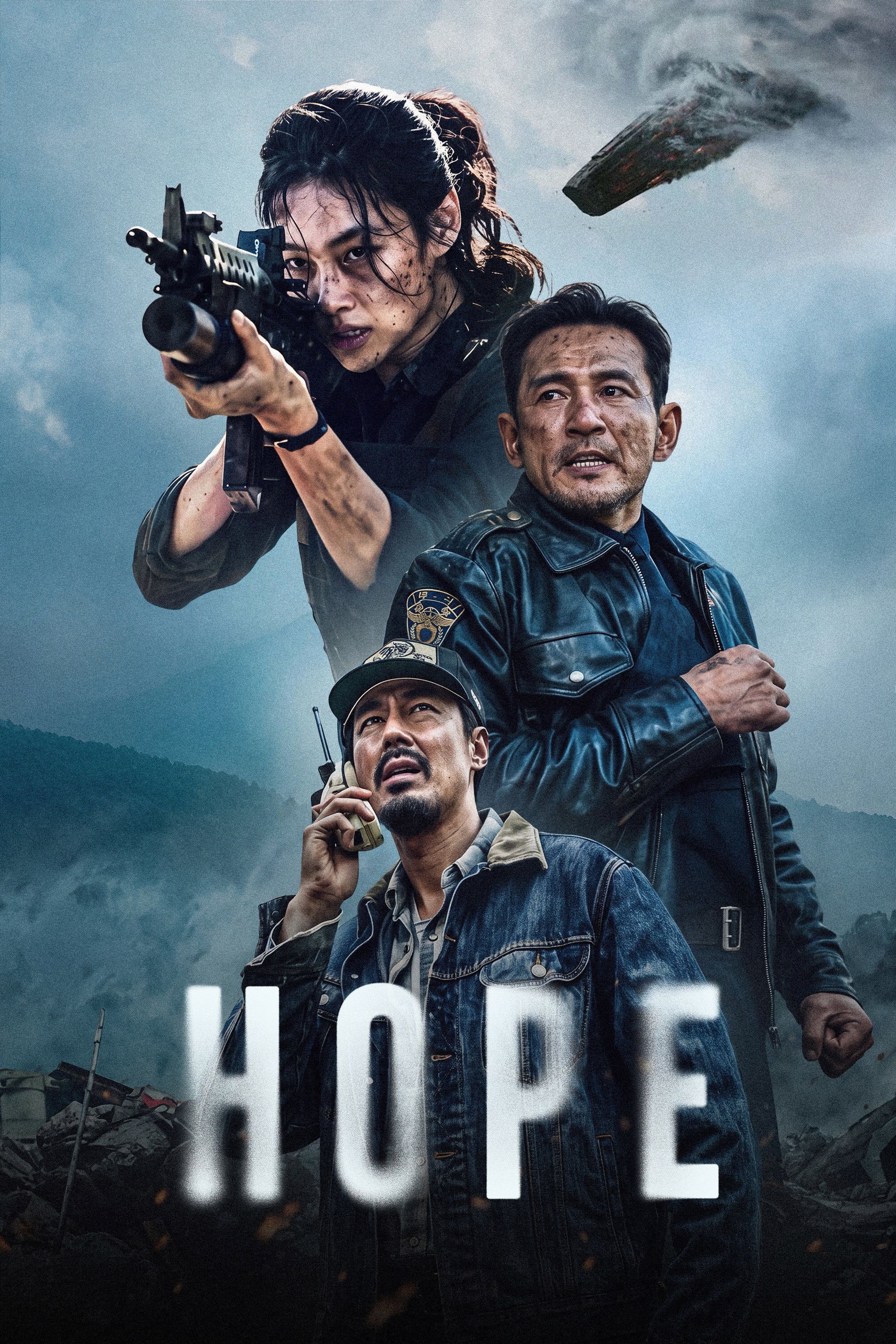
The most frightening thing in Na Hong-jin’s HOPE is not the creature. It is how quickly everyone decides what the creature must be.
Spoiler warning
This review discusses major plot developments, character revelations and the ending of HOPE.
The Trap of the Familiar
On paper, the premise is one of the oldest in the genre. Something extraterrestrial lands near a remote community, and the people who live there are left to survive it. Cars are flung across streets. Buildings come apart. Residents grab whatever weapons they can find and discover that none of them is enough.
Na uses that familiarity as camouflage. For its first stretch, HOPE plays like exactly the kind of monster movie its poster promises, with Police Chief Ko Bum-seok stranded at the center of a crisis he has no training for and little backup to face. The pleasures on offer are the traditional ones: escalating dread, practical stakes, a hero improvising as the situation worsens.
Then the film starts to withdraw its own certainties, one by one, until the audience realizes it has been watching the wrong story.

A Body Built to Be Feared
The design of Va’migere, performed by Cameron Britton, deserves its own paragraph of praise. The creature is tall and skeletal, with pale blue-grey skin, a long humanoid face and a cluster of twisting appendages that trail from its back. Its eyes sit deep in dark hollows, and its fingers stretch past anything human proportions would allow.
It is a thoroughly uncanny presence, close enough to a person to disturb and far enough from one to repel. The look is a deliberate piece of misdirection. Everything about the creature’s appearance tells us to recoil, which makes the film’s later insistence that we look closer feel like a dare rather than a lecture.
The Shot That Started It All
The real inciting incident arrives before the carnage, and it is almost embarrassingly small. A local named Yang-bae comes across a young alien and kills it. There is no hesitation in the staging, no attempt at curiosity, no consideration of what the creature might be or who might come looking for it.
That is the sort of detail a lesser film would treat as a quick setup. HOPE treats it as its thesis. The movie keeps returning to the same uncomfortable idea: when people meet something they do not understand, their first instinct is often to destroy it, and the bill for that instinct arrives later, addressed to everyone.
The monster is not the only character in HOPE who never learned to listen.
Grief With Claws
Once the audience learns that the dead creature was the offspring of the much larger being now tearing through the village, the film’s emotional register changes. Va’migere is not a predator hunting for sport. It is a parent in the first violent hours of mourning, and the rampage is a scream rendered in physical form.
What makes this work is that Na never lets sympathy slide into absolution. Va’migere’s anger is indiscriminate, and the villagers it harms had no part in the original act. They have families, homes and fears of their own. The film asks us to hold two ideas at once: that this creature’s suffering is real, and that its violence is catastrophic. Neither cancels the other, and the film is braver for refusing to pick one.
The contrast between the creature’s look and its motive is the engine of the whole picture. A being engineered to seem unknowable turns out to be feeling something every viewer has felt, or fears feeling. The horror is that recognition arrives too late to matter.
The Hesitation
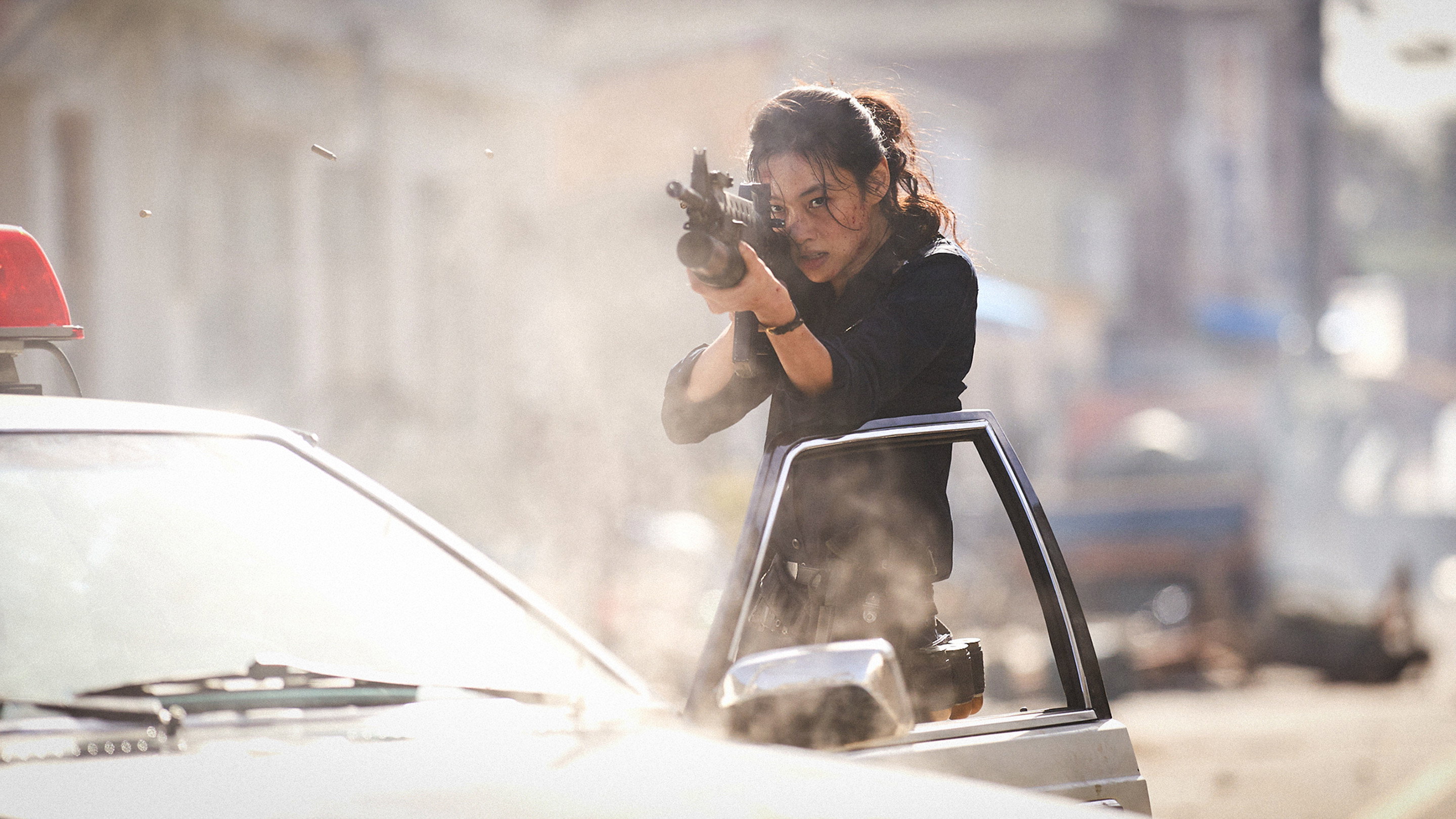
The film’s finest sequence is also its quietest. While pursuing the creature, Chief Ko gets a clean opportunity to shoot it, and he does not take it. Looking at the monster, he sees something unexpected in its face: sorrow.
It lasts only a moment, and the performance sells it without speeches. The creature stops being a target and becomes a person-shaped question. But the moment cannot hold. Va’migere’s grief curdles back into fury and it lunges, and the film makes a hard point about timing. Understanding is not a switch that can be flipped once the damage has begun. There is no conversation available, no apology that returns a lost child, and no guarantee that either side could stop fighting even if it wanted to.
Weapons, Excuses and Locked Doors
If Va’migere is the film’s wounded center, the human response is its sharpest satire. As the village turns into a battlefield, the authorities answer with carbines, assault weapons and grenades, and the stated goal shifts from understanding the danger to ending it.
Na is just as interested in the smaller failures that surround that firepower. After the accidental shooting of the local butcher, Colonel Ahn is preoccupied with getting a story straight rather than with the human cost in front of him. Elsewhere, deputies shut themselves inside locked offices while the community outside falls apart. These are not grand villains. They are ordinary people protecting themselves, their reputations and their paperwork, and the film finds them more unsettling than the thing in the road.
The movie is careful not to turn this into a case against self-defense. The villagers’ terror is reasonable, and fighting back is a matter of survival. The criticism is aimed at the assumptions underneath, and at how seldom anyone asks why the attack happened at all.
“What a Mess”
The climax is brutal and unglamorous. Already badly hurt, having lost a leg to a grenade, Va’migere is chased down a dirt road and finally crushed beneath a heavy tanker. There is no triumphant music to cue the relief. Ko and Deputy Sung-ae stand in the wreckage and survey it, and Ko delivers a blunt, profane verdict on the carnage that lands as both a joke and a eulogy.
It is the right note. The mess is not only the broken buildings. It is the dead, the injured and a community left permanently altered, all of it traceable to a single act of unnecessary violence. The threat is over, but the creature’s offspring is still dead and the village is still broken. Nothing has been won, only stopped.
What the Film Asks of You
HOPE will not satisfy everyone looking for a clean creature-feature thrill. Viewers who want a monster they can cheer against without complication may find that the film’s compassion keeps interrupting the fun. That tension is deliberate, and it is also where the movie earns its weight. It treats the audience as a participant who has to decide where sympathy ends and responsibility begins.
The film also has company in a long tradition of genre pictures that are misread because of how they look. Every Movie Plug’s Today in Cinema feature on a blockbuster once mistaken for the thing it mocked is a good companion to the way HOPE plays with audience expectations. For a view of how monster cinema is performing in theaters right now, the site’s reporting on the record-breaking opening of a new creature sequel shows how much appetite there still is for big-screen creatures. And for the craft behind bringing strange bodies to life, see how a creature workshop built a live-action Stone Age.
Our rating
HOPE (2026)
Verdict: HOPE disguises a human tragedy as an alien attack. Its creature is frightening, its supporting humans are damning and its most important scene is a man deciding not to fire. It is not a comfortable film, but it is a memorable one.
Frequently Asked Questions
Who directed HOPE?
Na Hong-jin directed HOPE, a science-fiction thriller set in the isolated South Korean village of Hope Harbor.
Who plays the creature Va’migere?
Va’migere is portrayed by Cameron Britton. The creature is a pale, skeletal extraterrestrial with elongated limbs and twisting appendages along its back.
Is the creature in HOPE the villain?
The film complicates the question. Va’migere is a grieving parent responding to the death of its offspring, but its rampage still harms innocent villagers. HOPE asks the audience to hold both facts at once.
What starts the conflict in HOPE?
A local resident named Yang-bae kills a young alien without trying to understand what it is. That act brings a much larger creature to the village.
Does HOPE contain spoilers in this review?
Yes. This review discusses key plot developments and the ending, so it is best read after watching the film.
Image Credits
Promotional images and stills are supplied by The Movie Database (TMDB) and belong to their respective rights holders, as credited beneath each image. This article uses the TMDB API but is not endorsed or certified by TMDB.
News
More on Every Movie Plug
 Box Office News Godzilla Minus Zero Breaks a 24-Year-Old Box Office Record Held by Harry Potter in Japan Godzilla Minus Zero broke Harry Potter and the Chamber of Secrets’ 24-year-old opening-day record in Japan and opened to an estimated $32M in North America. Read the story →
 Film News New Alien Movie in the Works From Ridley Scott and Raised by Wolves Creator, but Not a Romulus Sequel 20th Century Studios is developing a new Alien film written by Aaron Guzikowski with Ridley Scott producing. It is not a sequel to Alien: Romulus. Read the story →
 Film News Netflix Unveils The Take First Look With Denzel Washington and Robert Pattinson, Sets January 15 Release Netflix revealed the first poster and photos for The Take, the Fernando Meirelles heist thriller with Denzel Washington and Robert Pattinson, out January 15. Read the story →
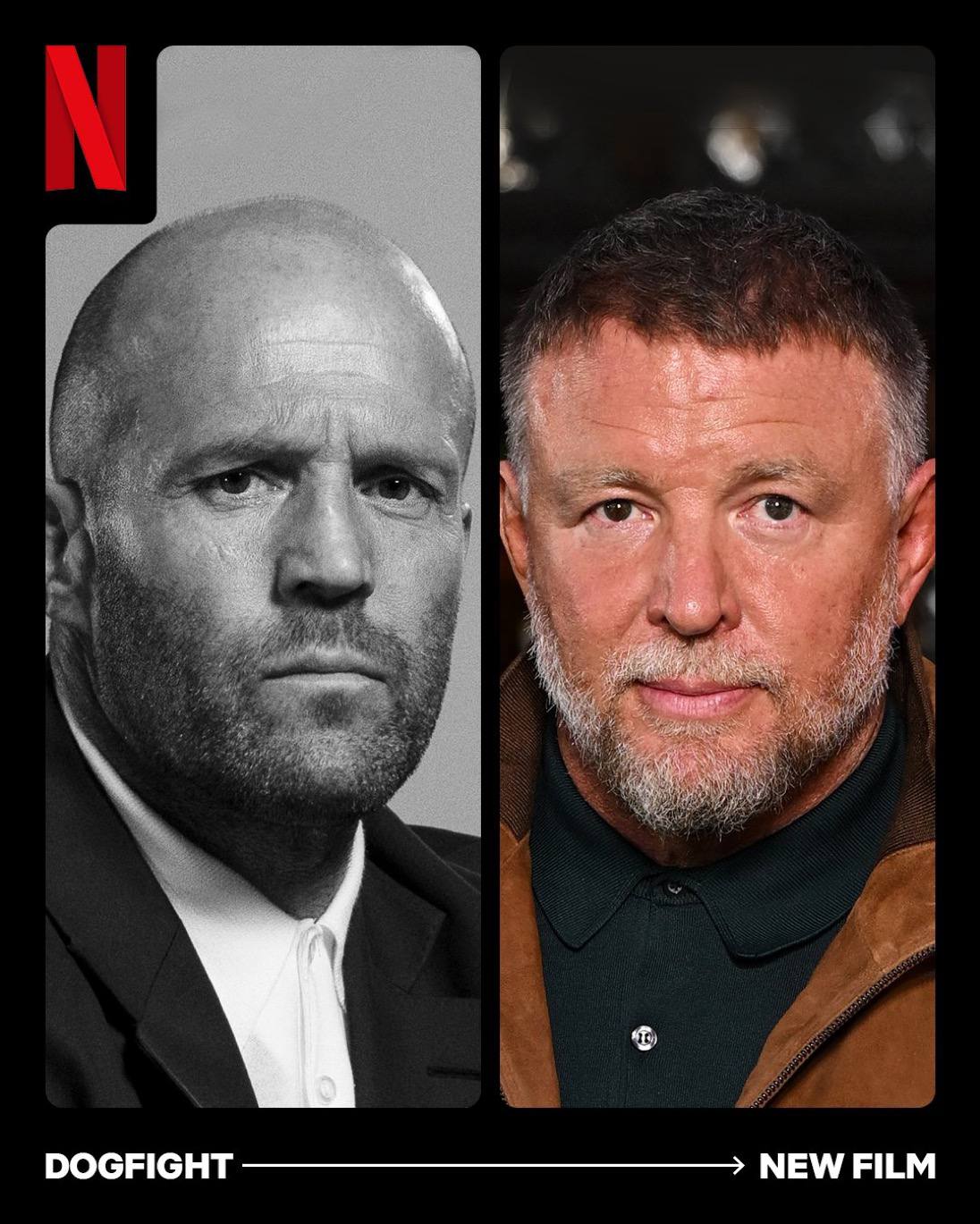 Film News Jason Statham and Guy Ritchie Reunite for Netflix Revenge Thriller Dogfight Netflix has announced Dogfight, a London-set revenge action film starring Jason Statham and written and directed by Guy Ritchie, with production due to start in early 2027. Read the story →
Articles
More on Every Movie Plug
 Today In Cinema Today in Cinema, November 7: Starship Troopers Invades Theaters in 1997 and Gets Mistaken for What It Mocks Starship Troopers opened November 7, 1997 and was called pro-fascist. How Verhoeven’s satire was made, why it flopped and why it is now a cult classic. Read the article →
 Behind the Scenes The Flintstones (1994): How It Was Made, Effects and Box Office How The Flintstones (1994) was made: Henson Creature Shop effects, the foam-built Bedrock set, 35 writers, harsh reviews and a $341.6M box office. Read the article →
 Article The Ending of The Graduate Explained The ending of The Graduate explained: the church chase, the bus ride, the fading smiles and what Mike Nichols, Dustin Hoffman and Katharine Ross said about it. Read the article →
 Today In Cinema Today in Cinema, November 10: Stranger Than Fiction Opens in 2006 and Lets Will Ferrell Meet His Author Stranger Than Fiction opened November 10, 2006. How Zach Helm’s narrator idea became Will Ferrell’s dramatic turn, what the ending means and why it endures. Read the article →