The strangest thing about Love & Other Drugs is how little of it comes from the book it claims to adapt. Jamie Reidy’s memoir, Hard Sell, is a wisecracking account of a young man who carried the bag for Pfizer in the late 1990s and discovered that the quickest way to sell a miracle pill was to charm the people who prescribed it. The film that opened on Wednesday, November 24, 2010, borrowed his job and his cheerful lack of shame, and then did something the memoir never attempted. It made the salesman fall in love with a woman who was going to get sicker, and asked whether he would stay.
That wager is the reason the movie is still worth arguing about sixteen years later. It also marks the third Thanksgiving-week opener in a row for our Today in Cinema series, following The Muppets yesterday and Back to the Future Part II the day before, which says something about how long Hollywood has treated the days before the holiday as prime real estate. Those two arrived with franchises behind them. This one had only two movie stars, a seasoned director and a plot that could have curdled in a dozen ways.

The Salesman Who Got Fired
Reidy’s real story is better known to people in the pharmaceutical business than to moviegoers. A Notre Dame graduate and former Army officer, he worked for Pfizer from 1995 to 2000, then moved to Eli Lilly’s oncology division, where he found, as his own author bio puts it, that there are far fewer jokes about chemotherapy than about Viagra. When Hard Sell was published, Lilly fired him. Pfizer, by Reidy’s account, responded with a statement observing that it could not tell whether the book belonged in the fiction or non-fiction section.
That anecdote is the film’s true spiritual ancestor, because it sums up the tone Edward Zwick wanted: a business that is absurd and deadly serious at once. The movie uses real drug names and the Pfizer logo with an ease that startled some observers. Zwick said at the time that he had no contact with the company and that the logos were not product placement, which is exactly what a filmmaker would say if he were telling the truth, and exactly what a skeptic would not believe.
What the book offered was texture: the sample closets, the lunches for doctors, the contest for territory and the feeling that a charming enough person could talk his way into any office. What it did not offer was a story. The studio’s solution, shaped by Zwick and his longtime collaborator Marshall Herskovitz together with screenwriter Charles Randolph, was to invent a second plot and let it take over.
Inventing Maggie
Zwick is best known for epics, from Glory to The Last Samurai, but his television roots matter here. He and Herskovitz built their careers on thirtysomething, a series about adults who talk too much and feel too much, and the film shows it. Maggie Murdock, a 26-year-old artist with early-onset Parkinson’s disease, did not appear in Reidy’s memoir at all. She is a pure invention, and the film’s central bet.
The risk was obvious. A story about a charming cad redeemed by a sick woman has been told so many times that it has its own clichés. The screenplay avoids the worst of them mostly by making Maggie the one with the power. She does not want to be rescued. She wants company without conditions, and she says so, sometimes cruelly. When Jamie starts researching her condition, driving her to specialists and rearranging his life around it, she pushes him away, because she can tell that he is falling in love with her tragedy rather than with her.
That reversal is the moment the movie earns its title. The film’s other drug is what people take to avoid a feeling, whether it is a pill, a joke or a one-night arrangement, and the real cure is the thing that frightens them. It is a more grown-up idea than its marketing suggested, and it is the reason the film survives its own tonal swerves.
A Contract of Trust
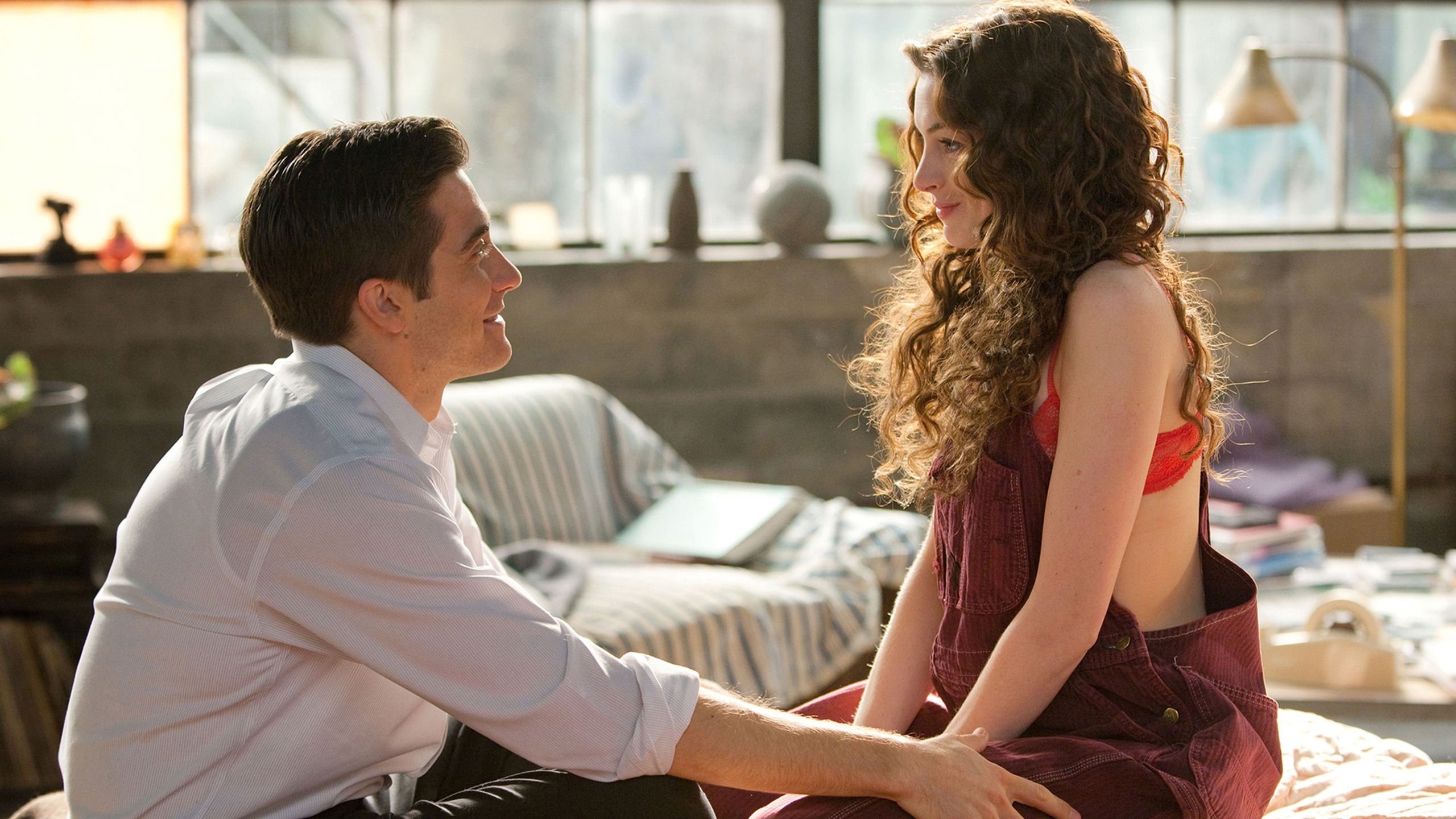
Gyllenhaal and Hathaway were not strangers. They had shared scenes in Brokeback Mountain, where Hathaway played Jack Twist’s wife, and they arrived with a working shorthand that the film needed, because the first half is built on a physical frankness that American studio movies were already starting to avoid. The nudity was unusual for two stars of their profile, and the production handled it with care. Both actors reportedly had final cut over their intimate scenes, and Hathaway used hers to trim only a few seconds that she felt lingered too long.
Zwick took an unconventional route to putting everyone at ease. At one point during shooting he is said to have stripped off and joined the actors in bed for a group shot, an act of solidarity that Gyllenhaal has treated with predictable comic restraint.
“No, it didn’t help me at all.”
The sillier stories obscure the work behind the other half of the performance. Hathaway prepared by meeting people living with Parkinson’s, including the actress Lucy Roucis, who appears in the film as a woman at the Parkinson’s convention and whom the cast singled out as one of its funniest presences. The film’s scenes at that gathering are among its most affecting. Jamie, who has been ready to talk his way out of any difficulty, stands in a room of strangers and has nothing to say. Gyllenhaal, for his part, spent time with Reidy, picking up the salesman’s patter and the faintly embarrassed way he talks about what he used to do.
Pittsburgh in the Nineties
The film was shot mainly in and around Pittsburgh, beginning in September 2009, and the city plays the role of a 1990s Rust Belt town in transition, a place where a young man could lose a job at an electronics store and land one at a pharmaceutical giant in the same week. The production even stretched the map: Pittsburgh doubled as Chicago for some scenes, and a stretch of Aliquippa, in Beaver County, turned into a film set for a day.
The choice paid off in tone. The era in the film is not a candy-colored throwback. It is the late 1990s, the age of pagers and bulky phones, of the dot-com bubble that makes Jamie’s younger brother rich enough to get him a foot in the door. Viagra arrives like a cultural event, and the film treats it as a story about how modern medicine became a consumer product long before most people noticed.
The brother is played by Josh Gad, years before Frozen made him the voice of a talking snowman, and he is one of the film’s great pleasures. His Josh is a slob, a millionaire, an oversharer and, quietly, the only person who tells Jamie the truth. Oliver Platt and Hank Azaria supply the industry satire, Platt as a boss who sees Jamie as his ticket to a better office and Azaria as a doctor with a talent for being sold to. Judy Greer, Gabriel Macht and George Segal round out a cast with room to breathe.
The Last Role of Jill Clayburgh
One of the film’s supporting players did not live to see it open. Jill Clayburgh, who plays Jamie’s mother, Nancy, died on November 5, 2010, the day after the film’s world premiere at the AFI Fest, where it had been the opening-night gala. She was 66. The film is dedicated to her memory, and both Zwick and Gyllenhaal spoke publicly about how alive she seemed on set. It is a poignant footnote for a movie so occupied with the question of how people live with a disease that does not go away.
Clayburgh was twice nominated for an Oscar, for An Unmarried Woman and Starting Over, in an era when American films made room for adult women with complicated inner lives. Love & Other Drugs belongs, at least in spirit, to that tradition. It is a studio romance aimed at adults, with sex, illness and an ending that is not tidy, and it arrived at a moment when the studios were starting to leave that territory.
A Crowded Holiday
The business context explains a lot. Twentieth Century Fox opened the film in 2,455 theaters on Thanksgiving week, directly into the wake of Harry Potter and the Deathly Hallows: Part 1, a franchise whose earlier chapters we visited in our look at Chamber of Secrets, and alongside Disney’s Tangled, which took the family audience. The adult romance earned $9.7 million in its first three days and about $13.9 million across the five-day holiday stretch.
It was a modest start, but it had legs. The film closed with roughly $32.4 million in the United States and Canada and $70.5 million overseas, for about $102.8 million worldwide against a $30 million budget. By the standards of an R-rated romance with no franchise behind it, that was a respectable result, and it showed how much the picture depended on its leads. The same Thanksgiving corridor still shapes the box office. This weekend, Lionsgate’s Sunrise on the Reaping took $56 million on its opening Friday, a very different kind of opener than the one Zwick was selling.
Update (Nov 24, 2026): The film opened on a Wednesday, the day before Thanksgiving, so its first-week figures are usually quoted as both a three-day weekend and a five-day holiday total.
Mixed Reviews, Lasting Argument
Critics were divided. The film holds a 49 percent approval rating on Rotten Tomatoes from 168 reviews and a 55 on Metacritic, and audiences gave it a B- on CinemaScore. Roger Ebert awarded two and a half stars and appreciated how the story moved from comedy toward tenderness. James Berardinelli, who gave it three and a half out of four, singled out its identity as an adult romance. The Los Angeles Times said Zwick had matured in handling relationships, and Time’s Mary Pols welcomed a studio movie that let its stars be intimate on screen at a moment when American films were prudish about it.
The harsher notes were just as consistent. A. O. Scott of the New York Times found it a heady, uneven mix, delighted by the romance and the workplace comedy but jolted by the medical melodrama. J. R. Jones of the Chicago Reader called the satire of the drug industry watered down. Both complaints are fair. The film wants to be a skewering of the pharmaceutical business, a screwball comedy, a love story and a drama about chronic illness, and it does not always know which one it is in.
What nobody disputed was the chemistry. The film earned Golden Globe nominations for both leads, in the Best Actor and Best Actress categories for a musical or comedy, and Hathaway won the Satellite Award for Best Actress in that category. She spent the following February co-hosting the Oscars with James Franco, which put her in front of one of the biggest television audiences of the year. Neither won the Globe, but the movie did what a good vehicle is supposed to do: it showed what they could do when someone gave them a real scene to play.

The Part That Still Lands
The film’s most durable idea is not the romance but the system around it. Jamie’s job is to persuade doctors to prescribe, and Maggie’s life is shaped by what she can afford and what she can get. The third act puts her on a bus full of seniors headed to Canada for cheaper medication, an image that was already a political story in 2010 and has not stopped being one. The film does not make a speech about it. It simply lets the audience see what the price of a pill looks like when you have to travel for it.
The performance that holds it together is Hathaway’s. She plays Maggie as someone who has decided in advance not to be pitied, and she lets the control crack in small, specific ways, in a hand that will not hold still, or in a joke that arrives a beat too fast. It is a worthy companion to the argument in our story on Mahershala Ali saying two Oscars do not guarantee him roles: good material is the scarce resource, and a star proves herself by what she does with it.
It also helps explain why the movie feels increasingly rare. Mid-budget, R-rated romances for grown-ups have thinned out in theaters, and much of that audience now finds its stories at home, part of a wider shift in how the entertainment economy spends its attention.
Sixteen Years Later
Hathaway’s present makes the film look like a hinge. In 2026 she has five films in release, among them The Devil Wears Prada 2, Christopher Nolan’s The Odyssey, the A24 pop-star drama Mother Mary, the dinosaur thriller The End of Oak Street and the Amazon MGM adaptation Verity, a run that industry observers have described as a movie star at full power. Love & Other Drugs is where that range was first widely visible: comedic timing, physical honesty and an unglamorous willingness to play a woman who is difficult on purpose.
The film itself has settled into a particular place in the culture. It is not a classic, and it has never been mistaken for one. It is something more useful: a film that took a risk on tone, trusted two actors with its most vulnerable scenes and ended on a note of commitment that is sweet without being simple. Jamie turns down the promotion and stays. There is no cure and no miracle, only a decision to be there.
That is a small ending for a movie that begins with a man selling the idea of a miracle. It is also the right one. After a career of persuading people that a pill can fix them, Jamie learns that the thing he cannot sell is the one that counts.
Love & Other Drugs is available through rental and purchase services and on select streaming platforms, so check current listings for your region.

- Wikipedia: Love & Other Drugs
- Wikiwand: Love & Other Drugs
- Box Office Mojo: Love & Other Drugs (2010)
- The Numbers: Love and Other Drugs (2010) box office
- Los Angeles Times: Disney can give thanks for 3-D Tangled
- Rotten Tomatoes: Love & Other Drugs
- Metacritic: Love and Other Drugs
- Roger Ebert: The other drugs are easier to sell
- The New York Times: A. O. Scott on Love & Other Drugs
- The New York Times: Edward Zwick’s Love and Other Drugs
- The Hollywood Reporter: Love and Other Drugs film review
- Variety: Love & Other Drugs review
- Chicago Reader: J. R. Jones on Love & Other Drugs
- NPR: Love And Other Drugs, a worthy prescription
- Fast Company: How Hollywood sexes up the inside story of a Viagra salesman
- CBS News: Gyllenhaal, Hathaway to star in movie about Pfizer sales rep
- Showbiz411: Director says Pfizer had no say about the movie
- Google Books: Hard Sell, the evolution of a Viagra salesman
- Indiewire: Anne Hathaway was unsure about role and 6 other things about Love and Other Drugs
- IMDb: Love & Other Drugs trivia
- The Hollywood Reporter: Jill Clayburgh in memoriam
- Beaver County Times: Aliquippa becomes film set for a day
- Golden Globes: Love & Other Drugs
- Motion Picture Association: Anne Hathaway’s remarkable five-film tour de force
- Image credit: 20th Century Fox and Regency Enterprises, via TMDB
News
Latest on Every Movie Plug
 Celebrity News Mahershala Ali: Two Oscars Don’t Guarantee Roles Mahershala Ali says two Oscars do not guarantee roles, because most greenlit projects have no part for him. Here is what he said and what comes next. Read the story →
 Box Office News Sunrise on the Reaping Box Office: $56M Friday, $120M Eyed The Hunger Games: Sunrise on the Reaping earned $56M on opening day and is tracking for about $120M, Lionsgate’s first $100M launch since 2015. Read the story →
Articles
Latest on Every Movie Plug
 Today In Cinema Today in Cinema, November 23: The Muppets at 15 A franchise nobody was asking for, a skeptical script, a songwriter forbidden to say “puppet” and one very large Thanksgiving bet: how a frog and his friends talked their way back into theaters. Read the article →
 Today In Cinema Today in Cinema, November 22: Back to the Future Part II at 37 A future built to be wrong, one actor in three roles, a lawsuit that reshaped actors’ rights and a cliffhanger sold at the end credits: the sequel that gambled with time. Read the article →
 Article Today in Cinema, November 15: Harry Potter and the Chamber of Secrets Opens in 2002, Told in Ten Numbers A 249-foot set, a nine-foot spider and an actress who was 37 playing 14. The second Potter film was built at speed, opened to a record and said goodbye to its Dumbledore. Read the article →