In the second week of November 1998, a certain kind of moviegoer arrived at American multiplexes, bought a ticket to a three-hour love story about Death, and left the moment the trailer they had come for finished playing. By several accounts, they had not come for Brad Pitt at all. They had come for a couple of minutes of footage from a different film entirely: the first look at Star Wars: Episode I – The Phantom Menace, which was playing in front of Meet Joe Black. The trailer ended. They went home.
It is a funny footnote, and a slightly cruel one, because it captures the film’s fate in miniature. Meet Joe Black opened on November 13, 1998, carrying a $90 million budget, two of the most famous actors in the world and a premise as old as the theater itself. What it got in return was a third-place debut, a pile of lukewarm reviews and, eventually, a confession from its own leading man that he had “muffed it.” And yet the film refused to die, which, given the subject, may be the only joke it did not intend.
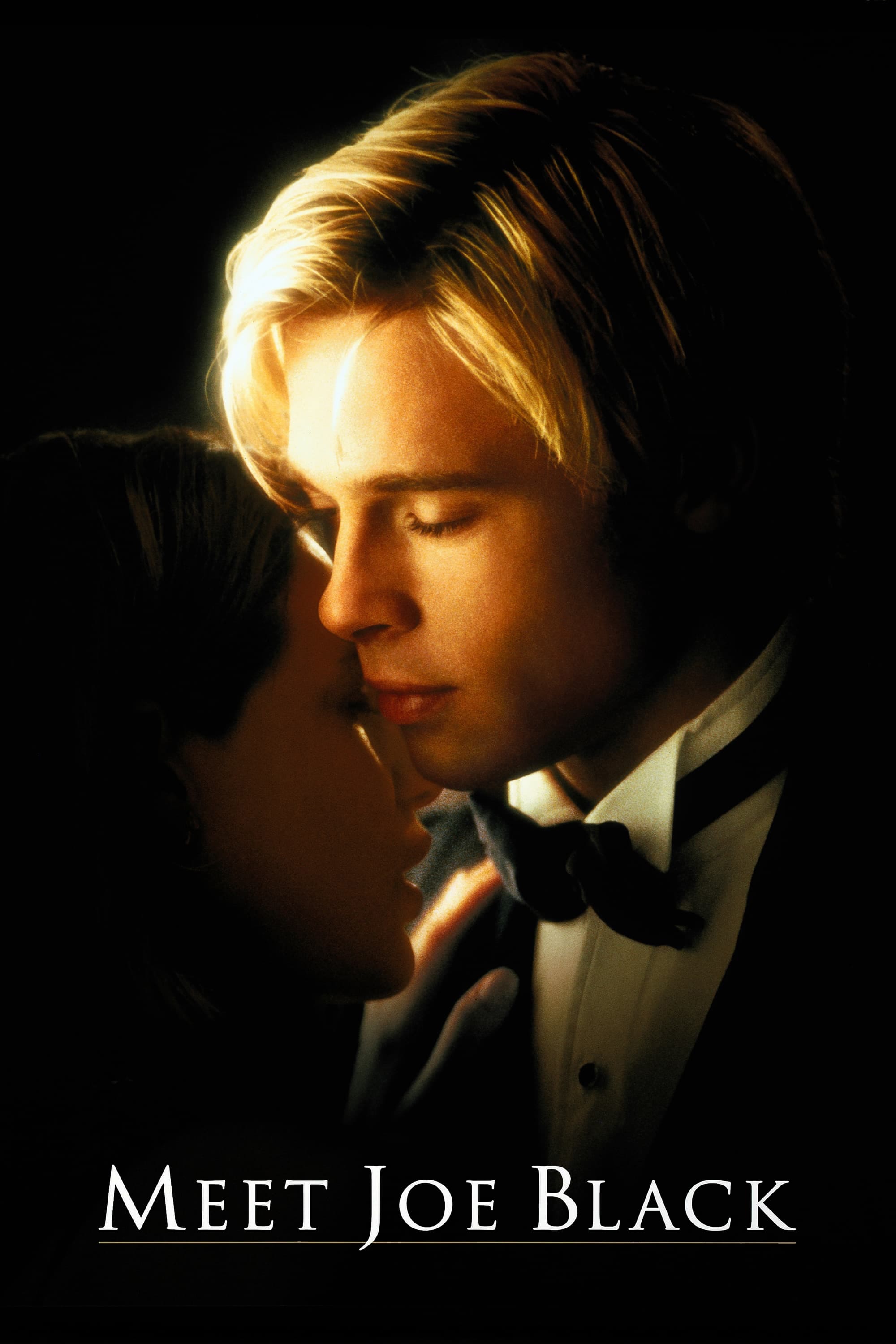
An Idea Older Than the Movies
The story of Death taking a holiday to learn what he has been taking away did not begin in Hollywood. It began on the Italian stage in 1924, with Alberto Casella’s play La morte in vacanza, which was adapted for English-speaking audiences by Walter Ferris and reached the screen in 1934 as Death Takes a Holiday, in a screenplay by Maxwell Anderson and Gladys Lehman, with Fredric March in the title role. Meet Joe Black is, by its own credits, a loose remake of that picture, and it inherits its central device intact: a supernatural visitor, a mortal host, a young woman in the way.
What the 1998 version added was scale. Martin Brest, who had directed Midnight Run and Scent of a Woman, directed and produced it from a screenplay credited to four writers, among them Bo Goldman, the veteran behind One Flew Over the Cuckoo’s Nest. He cast Anthony Hopkins as William Parrish, a media mogul on the eve of his 65th birthday, and Brad Pitt as the unnamed young man whose body Death borrows. It was the second time the two actors had worked together, after the family saga Legends of the Fall in 1994.
One critic at the time offered a theory for the film’s ambition, suggesting that Universal had looked at what a boyish, famously beautiful star had done for Titanic and reasoned that Pitt might do the same for a long, mournful romance. It is a cynical reading, but it is not an unreasonable one. In 1998, Pitt was the sort of star around whom a studio could build a three-hour movie and expect the world to show up.
The Man in the Coffee Shop
The film earns its first genuine moment before Pitt has said a word as Death. Susan Parrish, a young doctor in internal medicine, stops into a Manhattan coffee shop and falls into an easy, flirtatious conversation with a stranger. Neither asks the other’s name. She walks away; he walks out into the street, and is hit by a car. It is a small, well-made scene, and everything that follows depends on it, since the body Death will wear is this man’s, and the one person who might recognize it is Susan.
Meanwhile, Bill Parrish has been hearing a voice. It says that the answer to a question he has not yet asked is “yes,” and the question, of course, is whether he is going to die. When the voice finally takes shape at the family dinner table, Death proposes a bargain. He will postpone Bill’s end for as long as Bill agrees to act as his guide to the human world, and Bill, improvising, introduces his strange new companion as Joe Black.
From there the film becomes a comedy of manners, a corporate thriller and a love story at once, and its three hours begin to show. Joe discovers food, most memorably peanut butter, and the film lingers on his wonder at ordinary pleasure. Susan, intrigued by a man who seems both blank and strangely tender, falls for him. A scheming executive named Drew, played by Jake Weber, takes advantage of Bill’s odd dependence on his guest to arrange a boardroom coup, while Marcia Gay Harden and Jeffrey Tambor play Bill’s elder daughter and her husband, caught in the middle.
In the best sequence of the middle hour, Joe visits one of Susan’s terminally ill patients, a Jamaican woman played by Lois Kelly Miller, who senses at once what he is. He comforts her as she dies. It is the film at its most direct, and it is the closest it comes to saying what Death might actually be: not a villain, not an enemy, but an inevitability that is, in its way, merciful.

Hopkins Carries It; Pitt Pays for It
If there is one point on which the critics of 1998 agreed, it is that Anthony Hopkins was the film’s heart. Peter Travers of Rolling Stone called Bill Parrish the only fully realized character in the movie, and Mick LaSalle of the San Francisco Chronicle wrote that Hopkins’s acting was so emotionally full that even the smallest moments carried layers of thought and feeling. The performance is built from restraint: a man negotiating with the one force he cannot buy, argue with or outwork, doing it with the courtesy of a host.
Pitt fared worse. LaSalle found his performance so bad that it hurt, and James Berardinelli called it execrable. The part is a real challenge. Death, newly human, has to be both a blank slate and a presence of unnerving gravity, and Pitt plays it with a slow, wide-eyed stillness that some viewers found hypnotic and others found vacant. Years later, he sided with the harsher critics. Speaking to Entertainment Weekly in 2011, he described the film as the low point of a period when he had lost his direction, and said bluntly that he had not done the job well.
“I dogged it. I muffed it.”
It is a striking thing for a star to say about a film that audiences, as it turned out, rated an A-minus. The distance between the two judgments is the film’s whole story. Pitt’s later career, covered in Every Movie Plug’s Brad Pitt Actor Spotlight: Performance, Pivots, Filmography, is in large part the story of a star who learned to build his second act behind the camera, as a producer of films like The Departed. Seen in that light, the self-criticism reads less like a dismissal than a turning point.
The supporting players deserve a word. Claire Forlani, as Susan, is asked to fall in love with a man who is, for most of the film, a mystery, and she makes the feeling believable. Her work earned a Saturn Award nomination, as did Hopkins’s. The ensemble around them is solid, and the film’s weakest scenes, the boardroom intrigue, are weak because of the writing rather than the actors.
What Three Hours Buys You
The look of the film is very much of its moment: rich, golden and unhurried. Emmanuel Lubezki, who would later win three consecutive Academy Awards for Gravity, Birdman and The Revenant, shot it, and Thomas Newman, the composer of The Shawshank Redemption and American Beauty, wrote a score that critics have continued to single out as one of his finest. The music, with its patient, searching piano and strings, does much of the emotional work that the dialogue sometimes cannot.
The production spent five months in front of cameras, from June 11 to November 12, 1997, and its settings did much of the storytelling. Most of Bill’s country mansion was filmed at the Aldrich Mansion in Warwick, Rhode Island, while the penthouse and office interiors were sets built inside the 14th Regiment Armory in Brooklyn. The coffee shop where Susan and the young man meet was a real place, the Broadway Restaurant on the Upper West Side, which closed for good in June 2023 after 43 years.
Then there is the running time. The film plays at roughly three hours, which was the single most common complaint in 1998 and remains so today. A two-hour version was later prepared for television and airline screenings, cutting most of the business plot. Brest disliked it so much that he had his name removed, and it carries the pseudonym Alan Smithee, the credit Hollywood reserves for directors who disown their work. It is a small irony that the film’s least popular storyline, the boardroom, is the one that can be cut without destroying the rest.

A Strange Weekend at the Box Office
Meet Joe Black premiered as the closing-night film of the Tokyo International Film Festival on November 8, 1998, and opened across the United States and Canada on the weekend of November 13 to 15. It earned $15.0 million, good for third place behind the second weekend of The Waterboy and the opening of I Still Know What You Did Last Summer. For a film with this budget and this cast, it was a disappointment.
The Star Wars trailer did not help. It is hard to know exactly how many viewers bought a ticket only to see it, but the story was reported widely enough to become part of the film’s identity, and it speaks to the way a movie’s fate can be shaped by what plays in front of it. (The collision of two giant releases on a single weekend is a theme that Every Movie Plug explores in a very different context in the Dunesday Survival Guide.)
The domestic total finished at $44.6 million, well short of the budget. Overseas, though, the film found its audience. It earned another $98.3 million abroad, for a worldwide gross of $142.9 million, which means it more than recovered its costs on the strength of international ticket sales. The pattern is familiar to anyone who follows the business: a film that stumbles at home and succeeds elsewhere is rarely the failure that its American opening suggests.
The Reviews, and the Razzie
Critical response was mixed. Rotten Tomatoes lists a 48 percent approval rating from 52 reviews, with a consensus that the film is pretty to look at but undone by a punishing runtime, and Metacritic gives it a 43 out of 100. The most generous review among the major critics came from Roger Ebert, who gave it three stars and wrote that, flaws and all, there was so much that was fine in the movie. He disliked the peripheral subplots and the long, drawn-out ending, but he was willing to forgive them.
The film received a Golden Raspberry nomination for Worst Remake or Sequel, a dubious honor that says more about its source material than its quality. It also received the Saturn nominations for Hopkins and Forlani. Audiences, surveyed by CinemaScore, graded it A-minus, a mark that has proved more predictive of the film’s afterlife than the notices.
The Question Under the Question
It is easy to list what is wrong with Meet Joe Black, and critics have done so thoroughly. What is harder to explain is why it lasts. The answer is that it asks a question that very few mainstream films dare to ask directly: what, if you knew the date, would you want your last evenings to be?
Bill Parrish’s answer, delivered in a quiet birthday speech to his family, is not a grand one. He wants to thank people. He wants his daughters to be loved. He wants to dance. The film’s climax is not a battle or a chase but a father’s farewell, a last dance and the fireworks that begin as he walks across a bridge with Death, who assures him there is nothing to fear. And in a final, gentle twist, the young man from the coffee shop returns, with no memory of where he has been, and Susan is left to decide whether to begin again.
That tension, between acceptance and the stubborn wish for one more day, runs through a surprising number of recent stories. The same idea powers the 2006 comedy that Every Movie Plug revisited in Today in Cinema, November 10: Stranger Than Fiction Opens in 2006, in which a man who knows his death is coming has to decide what to do with the time. It is there in the grief at the center of Seven Ways Black Panther: Wakanda Forever Honors Chadwick Boseman, and in the way an audience learns to say goodbye to a character, or an actor, or an era.
The film’s central trick, an artificial being who learns what it means to be human, also has a long afterlife in popular storytelling. Marvel fans can see its echoes in the ongoing debate over the return of the android Vision, covered in Anthony Mackie Appears to Confirm Vision’s Return in Avengers: Doomsday and in the enigmatic teaser dissected in Marvel Studios Posts a Cryptic Binary Message on X Before the VisionQuest Finale. Different genre, same longing: a made thing, curious about the life it has been denied.
And the real-world versions of farewell are never far away. This season, the industry has been paying tribute to one of its great actors in Hollywood Remembers Sir Patrick Stewart: Tributes From Marvel, Star Trek and Co-Stars. Joe Black, for all his supernatural trappings, would have understood why those tributes matter.

Twenty-Eight Years Later
Meet Joe Black was not the film its makers hoped for, and it was not the film its critics wanted. It is too long, too gentle and too sure that a handsome stranger in a good suit can carry an existential drama. But it is also one of the few mainstream studio films of its decade that is willing to sit with a single question for three hours without looking away from it, and the best of it, Hopkins’s dignity, Newman’s score and the peaceful mercy of the final walk, holds up.
That may be why it has outlasted the box-office disappointment, the Razzie nomination, the star’s own regrets and even the Phantom Menace trailer that stole its audience. It remains a film people return to, usually on a quiet evening and often by accident, and many discover the same thing on a second viewing: that the slow parts are slow on purpose. The film is available on home video and on a rotating basis on streaming services, so check current listings for your region.
As for Joe Black, he asked for one thing before the end. He wanted more time to understand what the living already know. The film suggests, with some tenderness, that most of us never quite get it either.
Credits and Sources
- Images: Universal Pictures and City Light Films, via TMDB. Related-story thumbnails: Every Movie Plug.
- Film details, plot, locations, release and reception: Meet Joe Black, Wikipedia; Box Office Mojo; IMDb
- Reviews: Roger Ebert; Rolling Stone; San Francisco Chronicle; ReelViews; Rotten Tomatoes; Metacritic
- Production and aftermath: The New York Times, 1997; Los Angeles Times on the Alan Smithee credit; Entertainment Weekly, Brad Pitt interview; CinemaBlend on the Phantom Menace trailer; Patch on the Broadway Restaurant
- Every Movie Plug news referenced: Anthony Mackie and Vision; Marvel and the VisionQuest finale; Sir Patrick Stewart tributes
News
Latest on Every Movie Plug
 Film News Anthony Mackie Appears to Confirm Vision’s Return in Avengers: Doomsday Anthony Mackie name-dropped Paul Bettany while describing the Avengers: Doomsday shoot. Marvel has not confirmed Vision. Here is what we know. Read the story →
 TV News Marvel Studios Posts a Cryptic Binary Message on X Before the VisionQuest Finale: What It Says and What It Means Marvel Studios posted a message in binary code on X before the VisionQuest finale. Here is what it says, where the line comes from and what fans expect next. Read the story →
 Film News Hollywood Remembers Sir Patrick Stewart: Tributes From Marvel, Star Trek and Co-Stars Sir Patrick Stewart has died at 86. Marvel Studios, the Star Trek family, Hugh Jackman, Seth MacFarlane and the Royal Shakespeare Company are among those paying tribute. Read the story →
Articles
Latest on Every Movie Plug
 Actor Spotlight Brad Pitt Actor Spotlight: Performance, Pivots, Filmography Brad Pitt’s career, analyzed: how his performances work, the turning points from 12 Monkeys to Plan B to F1, and which films carry real weight. Read the story →
 Today In Cinema Today in Cinema, November 10: Stranger Than Fiction Opens in 2006 and Lets Will Ferrell Meet His Author Stranger Than Fiction opened November 10, 2006. How Zach Helm’s narrator idea became Will Ferrell’s dramatic turn, what the ending means and why it endures. Read the story →
 Article The Ending of The Graduate Explained The ending of The Graduate explained: the church chase, the bus ride, the fading smiles and what Mike Nichols, Dustin Hoffman and Katharine Ross said about it. Read the story →