Today in Cinema looks at one major film that reached audiences on this date. This entry is about a sequel built around a loss, and the choices that made it a tribute as well as a blockbuster.
Picture the opening minutes. The audience has just watched a king die off screen, and a nation turn out in white to mourn him. Then the screen goes dark and the familiar Marvel Studios fanfare, the one that has introduced more than two dozen films, does not play.
There is no music. There is no rush of heroes flickering past. There are only moments of one man, T’Challa, in the purple light of Wakanda, played by Chadwick Boseman. At the film’s star-studded premiere in Hollywood, the change drew cheers and applause, and in theaters across the country on November 11, 2022, it drew something quieter and harder to describe.
That silence is the first of many choices in Black Panther: Wakanda Forever, which opened in the United States four years ago today. It is a film that could not be what it was meant to be, and so became something else. Boseman died on August 28, 2020, at 43, after a private battle with colon cancer. Marvel did not recast him, did not build a digital double and did not carry on as if nothing had happened. Instead, director Ryan Coogler and his collaborators rewrote the story around the absence. This edition of Today in Cinema counts seven ways the film honors him, and what happened when audiences came to see it.

If you only have a minute, the seven tributes in brief:
- The silence. A Marvel logo made entirely of T’Challa, with no music.
- The absence. T’Challa dies off screen and is never recast or digitally recreated.
- The women. Ramonda, Shuri, Okoye and Nakia carry the story, and the cast’s own grief is on screen.
- The fire. Shuri burns her mourning robe in a closing act of grief.
- The song. “Lift Me Up,” written as a tribute to Boseman.
- The child. An ending that uses archive footage and a new generation.
- The enemy. A villain shaped by loss, and a hero who chooses not to be.
A Film Rewritten by a Loss: The Timeline
Few blockbusters have had their direction changed as completely as this one. The sequel was planned for years, and the plan changed overnight.
- February 2018The first Black Panther opens. Producer Kevin Feige says there are many stories left to tell and wants Coogler back for any sequel.
- October 2018Coogler closes a deal to write and direct the sequel. Letitia Wright is confirmed to return as Shuri the next month.
- July 2019Feige confirms the sequel at San Diego Comic-Con. At D23 the following month, he says Coogler has finished a treatment that includes a villain and a new title.
- August 28, 2020Chadwick Boseman dies. Coogler is in the middle of writing and had already turned in a draft, spending a year imagining words for T’Challa.
- December 2020Feige says T’Challa will not be recast. The release date moves back.
- June 29, 2021Production begins at Trilith Studios in Atlanta under the working title Summer Break.
- October 15, 2021Dorothy Steel, the Merchant Tribe elder from the first film, dies while in the middle of reprising her role.
- November 2021Production pauses so that Wright can recover from a stunt injury. Producers confirm she is the film’s new lead.
- March 24, 2022Filming wraps in Puerto Rico.
- October 26, 2022World premiere at the El Capitan and Dolby theaters in Hollywood.
- November 11, 2022US release, and the largest November opening weekend ever at the time.
- March 12, 2023Ruth E. Carter wins the Oscar for Costume Design and makes history.
1. Silence Where the Fanfare Should Be
The Marvel Studios opening has been a fixture of the franchise for years, a quick montage of its heroes set to rousing orchestral music. For this film, that montage was replaced. Every still and clip belongs to Boseman as T’Challa, set to silence rather than music.
It works because it does not explain itself. Audiences already know what it means. A familiar brand ritual, repeated dozens of times, is suddenly turned over to a single person, and the quiet that follows is the closest the film comes to a eulogy delivered in the theater itself. It is also a reminder of how much of a franchise’s identity is built from its smallest repeated gestures, an idea that echoes in Hollywood Remembers Sir Patrick Stewart: Tributes From Marvel, Star Trek and Co-Stars, which covers how the studio and the wider industry respond when a familiar face is lost.
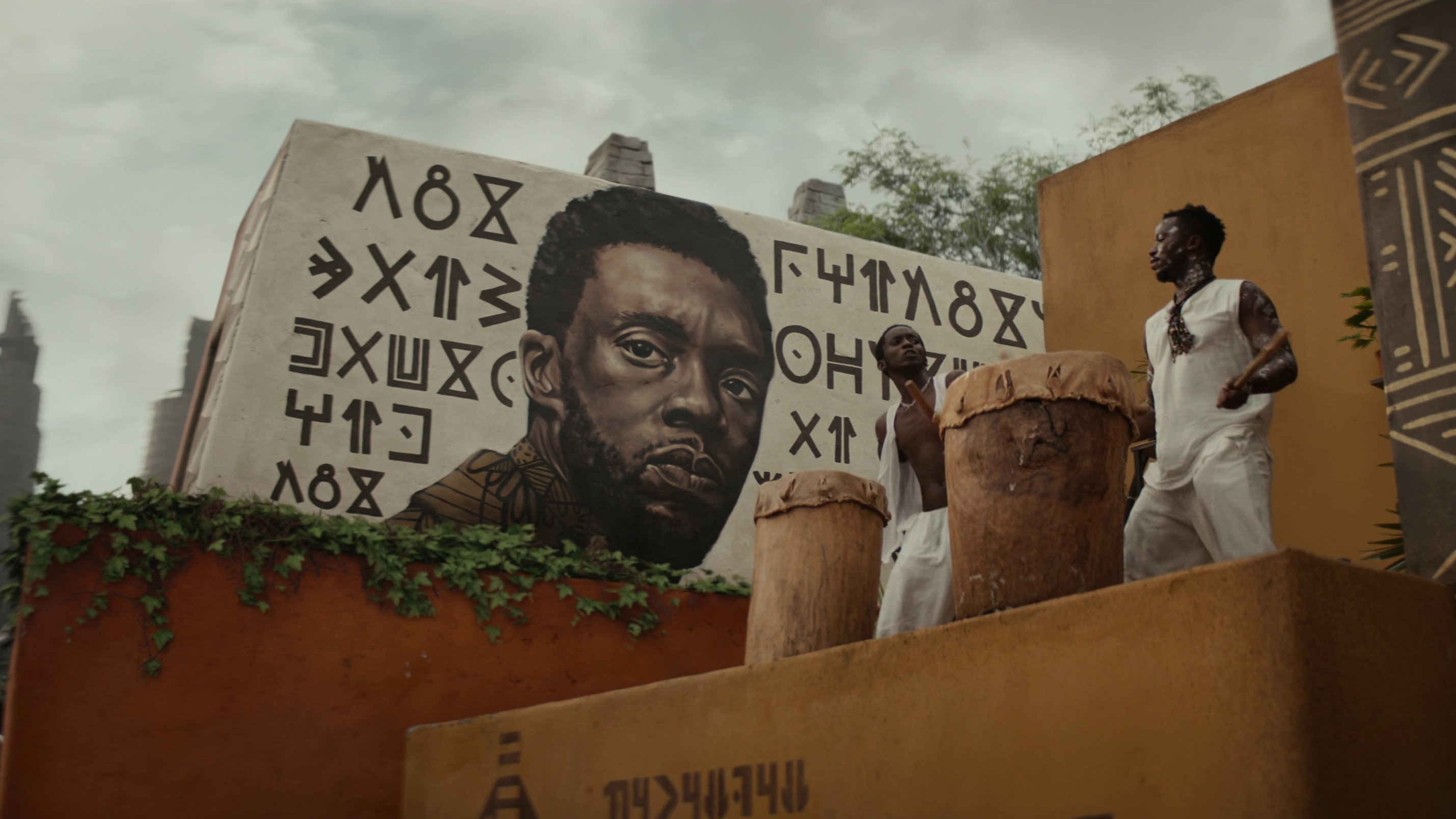
2. The Decision Not to Pretend
The harder choice came earlier, in the weeks after Boseman’s death. Industry observers suggested Disney might recast the role, but that risked a fan outcry and unfair comparisons. Others suggested having Shuri take the mantle, as in the comics. Marvel eventually chose a third path that was both simpler and more demanding: to say the character would not be replaced and to build the film around that fact.
“We will not recast the character”
Executive producer Victoria Alonso said that a digital double of Boseman would not be created, and Feige later said it felt much too soon to recast, with the world inside and outside the franchise still processing the loss. Coogler has described making the film without Boseman as the hardest thing of his career. He had not known about the illness and had spent the previous year imagining and writing words for T’Challa that the actor would never speak.
What he had planned is revealing. The original story would have followed T’Challa as he tried to resume his life after the Blip and meet a son he had never known. It centered on a ritual called the Ritual of Eight, in which father and child spend eight days in the bush, with the boy allowed to ask any question and the father required to answer. Namor was meant to attack in the middle of it. That version could not be made, and the finished film keeps its emotional shape: a family, a child who is not yet in the room, and a loss that rearranges everything else.
3. Four Women, One Grief
With T’Challa gone, the story passes to the women of Wakanda, and Coogler lets each of them grieve differently. Angela Bassett’s Queen Ramonda holds the throne together while mourning her son. Letitia Wright’s Shuri retreats into her laboratory and refuses to believe the Black Panther is still needed. Danai Gurira’s Okoye carries the guilt of a soldier who could not protect the people she was meant to guard. Lupita Nyong’o’s Nakia has been pushed to a distance, shaped by loss and by years apart.
This is not only a screenwriting device. The cast was grieving, and the production did not hide it. Wright and Gurira bonded by taking walks together on set, Gurira has described feeling emotional on entering the throne room because she remembered filming scenes there with Boseman, and Coogler helped her through it. Wright has said Boseman meant everything to her and was the reason she was there, having picked her to play his sister.
That is why the performances read as truer than the script requires. Bassett won the Golden Globe for the role and was nominated for an Oscar, making her the first actor to earn a major acting award for a Marvel film and the film the first Marvel production nominated in an acting category.
4. The Funeral Robe Burns
The film’s emotional hinge comes late. After the battle is over, Shuri travels to Haiti to see Nakia and the child she has been raising. There, she burns her funeral robe on a beach and finally allows herself to mourn T’Challa, honoring her mother’s wish that she do so.
The idea is carried into the film’s end credits. The main-on-end title sequence shows Shuri’s mourning clothes burning to reveal a Black Panther suit beneath. It was filmed practically, with controlled flames lit on cloth similar to Shuri’s using a specialized fireproof camera, rather than created on a computer. The choice is consistent with the film’s method: grief rendered as something physical and slow.
The film’s look supports it. Coogler explained that he chose anamorphic lenses because they warp the image slightly, matching a film with “the fog of loss over it,” since a profound loss can change how a person sees the world. The idea of closing a story on a single, charged image is a subject in its own right, and Every Movie Plug explores another famous example in The Ending of The Graduate Explained.

5. A Song Written as an Embrace
The film’s lead single, “Lift Me Up,” was released on October 28, 2022 and was Rihanna’s first solo music in six years. It was written by Tems, Ludwig Göransson, Rihanna and Coogler as a tribute to Boseman. Tems has said she wanted to write something that felt like a warm embrace from the people she had lost, and Coogler has said Rihanna recorded it for Chad.
It was not the film’s only musical tribute. The teaser trailer used Tems’s cover of Bob Marley’s “No Woman, No Cry,” which moved into Kendrick Lamar’s “Alright,” and the footage drew 172 million views in its first 24 hours. Göransson’s score blended African and Mesoamerican music, with Baaba Maal returning as a vocalist. A three-part Disney+ documentary, Voices Rising, later showed how it was made in Lagos, Mexico and London.
“Lift Me Up” was nominated for the Academy Award for Best Original Song, and Rihanna performed it at the ceremony, introduced by Gurira. It did not win, but the performance became one of the evening’s most discussed moments. Music is only one place where the film turns tribute into texture. The theme of hip-hop and film appears in another form in Today in Cinema, November 8: 8 Mile Opens in 2002, which looks at a song that won an Oscar on the strength of a story.
6. The Child, and the Footage That Closes the Film
The film’s only post-credits scene is also its most direct farewell. Shuri meets a boy named Toussaint, the son of T’Challa and Nakia, whom Nakia has been raising in secret. When she asks his name, he tells her his Wakandan name is T’Challa.
Archive footage of Boseman from earlier Marvel films appears near the end, which lets the film say goodbye to the character without inventing a new performance. Producer Nate Moore said the team never considered a second scene after the credits, since they felt the ending was too poetic and that a stinger would have been tonally disingenuous. Divine Love Konadu-Sun, the young actor who plays Toussaint, has said that the first film inspired him to act, and he prepared by watching Captain America: Civil War, where Boseman first appeared as T’Challa.
The child is no mere epilogue. Four years later, he is at the center of the franchise’s plans. At San Diego Comic-Con in July 2026, Feige and Coogler announced that David Jonsson would play an adult Toussaint, who will take up the Black Panther mantle in Black Panther III, scheduled for December 15, 2028, with Wright and Winston Duke returning. Casting for the character of the future is a recurring theme across Marvel news, including Jeremy Allen White: The Next Wolverine?, and the studio’s coy teasing of its own storylines, as in Marvel Studios Posts a Cryptic Binary Message on X Before the VisionQuest Finale.
7. An Enemy Made of Grief
The final tribute is quieter than the rest. The film’s villain is not a conqueror but a mirror. Namor, played by Tenoch Huerta Mejía, is the king of Talokan, a hidden underwater civilization shaped by centuries of loss from slavery and genocide, and he is determined that the surface world will not take what remains. He is a villain with a grievance that the film takes seriously, in the tradition collected in When Movie Villains Were Right: 10 Antagonists Who Had a Point.
Shuri’s test is not whether she can defeat him but whether grief will make her like him. In the Ancestral Plane, she meets Killmonger, played by Michael B. Jordan, who asks whether she will seek revenge or be as honorable as her brother. She chooses vengeance first, orders an assault on Talokan and gains the upper hand over Namor in their final fight. At the last moment she sees a vision of her mother urging mercy and stops. The woman who has lost everything chooses an alliance over another death.
That decision is the film’s argument. A hero’s memory is honored not by repeating his victories but by acting as he would. T’Challa, the king who closed the first film by opening Wakanda to the world, is present in the choice that his sister makes.

Beyond the Film: A Wider Circle of Tribute
The film was surrounded by other acts of remembrance. Three episodes of Marvel Studios: Legends were released on November 4, 2022 to revisit T’Challa, Shuri and the Dora Milaje, and a documentary special, The Making of Black Panther: Wakanda Forever, arrived on Disney+ on February 8, 2023. A six-episode podcast hosted by Ta-Nehisi Coates gathered interviews with the cast and crew. Dorothy Steel, who died during production, appears in her final role, a small detail that gives the Wakandan elders an extra weight.
The film also had a worldwide reach that mattered to its themes. It premiered in Lagos on November 6, 2022, which Deadline described as the first local premiere for a Marvel film, and it earned the biggest opening ever for any film in Nigeria. It reached China on February 7, 2023, becoming the first MCU film released there since 2019.
The Numbers: A Record Opening and a Steep Drop
The audience turned out. The film earned $84.3 million on its first day, including $28 million from Thursday previews, and finished its opening weekend with $181.3 million in the United States and Canada, the largest November opening weekend ever and ahead of The Hunger Games: Catching Fire. Its worldwide debut was $331.6 million, the third-largest of the pandemic era at that point.
The second weekend fell 63 percent to $66.5 million, but the film stayed at number one for five weekends before Avatar: The Way of Water displaced it. It finished with $453.8 million in the United States and Canada and $859.2 million worldwide, the sixth-highest total of 2022 and well below the first film’s $1.3 billion. Deadline calculated its net profit at $259 million.
Records of this kind are a recurring subject in Every Movie Plug’s box-office coverage, including the recent Godzilla Minus Zero Breaks a 24-Year-Old Box Office Record Held by Harry Potter in Japan. And the next event on the studio’s calendar is previewed in the Dunesday Survival Guide, which covers how to plan around Avengers: Doomsday.
What Critics Said
Reviews were generally positive. Rotten Tomatoes reports an 84 percent approval rating from 448 reviews, and Metacritic gives the film 67 out of 100 from 62 critics. Audiences polled by CinemaScore gave it an A. Empire gave it four stars out of five and described it as a passionate eulogy for Boseman, praising a strong sense of place and the performances of Wright, Duke, Bassett and Coel.
The criticism centered on scale and length. Variety’s Owen Gleiberman thought it was easily 20 minutes too long but admired its slow-burn emotional suspense. The Washington Post’s Ann Hornaday found the film stalled, and ReelViews gave it two stars out of four, praising Shuri’s arc but faulting the runtime and world-building. Even the skeptics usually singled out the cast, particularly Bassett.
Awards: Five Nominations and a Historic Win
At the 95th Academy Awards, the film received five nominations: Best Supporting Actress for Bassett, Best Costume Design, Best Makeup and Hairstyling, Best Visual Effects and Best Original Song for “Lift Me Up.” It won one. Ruth E. Carter took Best Costume Design, her second Oscar after the first film, making her the first Black woman to win two Academy Awards.
Carter used her speech to thank the Academy for recognizing the superhero that is the Black woman, and she acknowledged Boseman and Coogler. The film also earned a British Academy Film Award nomination, six Critics’ Choice nominations with two wins, two Golden Globe nominations with one win, and two Screen Actors Guild nominations.
How to Watch Wakanda Forever Today
The film arrived on Disney+ on February 1, 2023, including an IMAX Enhanced version, and on Ultra HD Blu-ray, Blu-ray and DVD on February 7, 2023. The home releases include audio commentary, deleted scenes, a gag reel and behind-the-scenes featurettes. Streaming availability changes, so check current listings in your region.
A good way to watch is to see the first Black Panther first, even if only to feel what is missing. The sequel works best when you know the man whose absence it is about.
Frequently Asked Questions About Wakanda Forever and Chadwick Boseman
When was Black Panther: Wakanda Forever released?
It premiered in Hollywood on October 26, 2022 and opened in the United States on November 11, 2022, after an international release that began on November 9.
How does Wakanda Forever honor Chadwick Boseman?
It opens with a silent Marvel logo made entirely of Boseman as T’Challa, builds its story around his character’s death, uses archive footage near the end, features the tribute song “Lift Me Up” and ends on Shuri’s act of mourning.
Why was T’Challa not recast?
Marvel producer Kevin Feige said Boseman’s portrayal was iconic and that it felt much too soon to recast, with the world still processing the loss. Marvel also did not create a digital version of him.
How much money did Wakanda Forever make?
It earned $859.2 million worldwide, including $453.8 million in the United States and Canada, and had the largest November opening weekend ever at $181.3 million.
Did Wakanda Forever win any Oscars?
Yes. Ruth E. Carter won Best Costume Design, making her the first Black woman to win two Academy Awards. The film had five nominations in total, including Angela Bassett for Best Supporting Actress.
Is there a Black Panther 3?
Yes. Marvel has announced Black Panther III for December 15, 2028, with Ryan Coogler directing. David Jonsson was announced in July 2026 as an adult Toussaint, with Letitia Wright and Winston Duke returning.
Conclusion: What a Tribute Is For
Wakanda Forever is imperfect and overlong, and it is sometimes pulled between mourning and franchise duty. But its best decisions are the ones that resist spectacle: the silent logo, the refusal to recast, the burning robe, the child who answers to his father’s name. Together they make a film in which the person being honored is felt most strongly in the places where he is not.
Today in Cinema returns with another film from movie history. Recent entries include Stranger Than Fiction, No Country for Old Men and Godzilla, another film in which a monster is a way of mourning.
Image and Source Credits
- Lead image and three scene images: Marvel Studios and Walt Disney Studios Motion Pictures, via TMDB
- Related-story thumbnails: Every Movie Plug
References and Further Reading
- Development, production, music, release, box office, reception and awards: Black Panther: Wakanda Forever, Wikipedia; D23, The Official Disney Fan Club
- The Marvel logo tribute and other tributes: Looper; SlashFilm; The Mary Sue; Yahoo Entertainment
- Box office: Motion Picture Association; Box Office Mojo; The Numbers
- Awards and legacy: Ms. Magazine; NABJ Black News & Views; The Root
- Reviews: Rotten Tomatoes; Metacritic; Empire
- Every Movie Plug news referenced: Sir Patrick Stewart tributes; Jeremy Allen White and Marvel; Marvel and the VisionQuest finale; Godzilla Minus Zero box office record
News
Latest on Every Movie Plug
 Film News Hollywood Remembers Sir Patrick Stewart: Tributes From Marvel, Star Trek and Co-Stars Sir Patrick Stewart has died at 86. Marvel Studios, the Star Trek family, Hugh Jackman, Seth MacFarlane and the Royal Shakespeare Company are among those paying tribute. Read the story →
 TV News Marvel Studios Posts a Cryptic Binary Message on X Before the VisionQuest Finale: What It Says and What It Means Marvel Studios posted a message in binary code on X before the VisionQuest finale. Here is what it says, where the line comes from and what fans expect next. Read the story →
 Casting News Jeremy Allen White: The Next Wolverine? Jeff Sneider reports Jeremy Allen White has met with Marvel about a role in the X-Men reboot. Marvel has not confirmed a Wolverine casting. Read the story →
Articles
Latest on Every Movie Plug
 Article The Ending of The Graduate Explained The ending of The Graduate explained: the church chase, the bus ride, the fading smiles and what Mike Nichols, Dustin Hoffman and Katharine Ross said about it. Read the story →
 Article When Movie Villains Were Right: 10 Antagonists Who Had a Point Ten movie villains who lost on screen but won part of the argument, from Killmonger and Magneto to Thanos and Roy Batty. Read the story →
 Article Dunesday Survival Guide: How to Watch Dune: Part Three and Avengers: Doomsday, and Which to See First Dune: Part Three and Avengers: Doomsday both open December 18, 2026. Runtimes, IMAX and premium formats, tickets, and which film to watch first. Read the story →