Today in Cinema looks at one major film from movie history that reached audiences on this date: how it was made, how it was received and why it still matters.
On November 7, 1997, a $100 million science fiction film about smiling young soldiers fighting giant insects opened in nearly 3,000 American theaters. Starship Troopers won its opening weekend with about $22.1 million, then lost more than half its audience the following Friday, collected some of the harshest reviews of its director’s career and left theaters with roughly $54.8 million in the United States and Canada. A Washington Post editorial went so far as to describe it as pro-fascist. Almost every one of those judgments has since been argued over, and many have been reversed.
Twenty-nine years later, Starship Troopers is regarded as a cult classic and, to a growing number of critics, one of the most subversive studio films ever made. The reason is the gap between what the movie appears to be and what it is doing. Paul Verhoeven set out to build a gleaming, attractive fascist society and then let the audience realize what it had been cheering for. This edition of Today in Cinema looks at how that trick was pulled off, why it nearly did not get made, and what happened when a satire met an audience expecting a summer popcorn adventure.
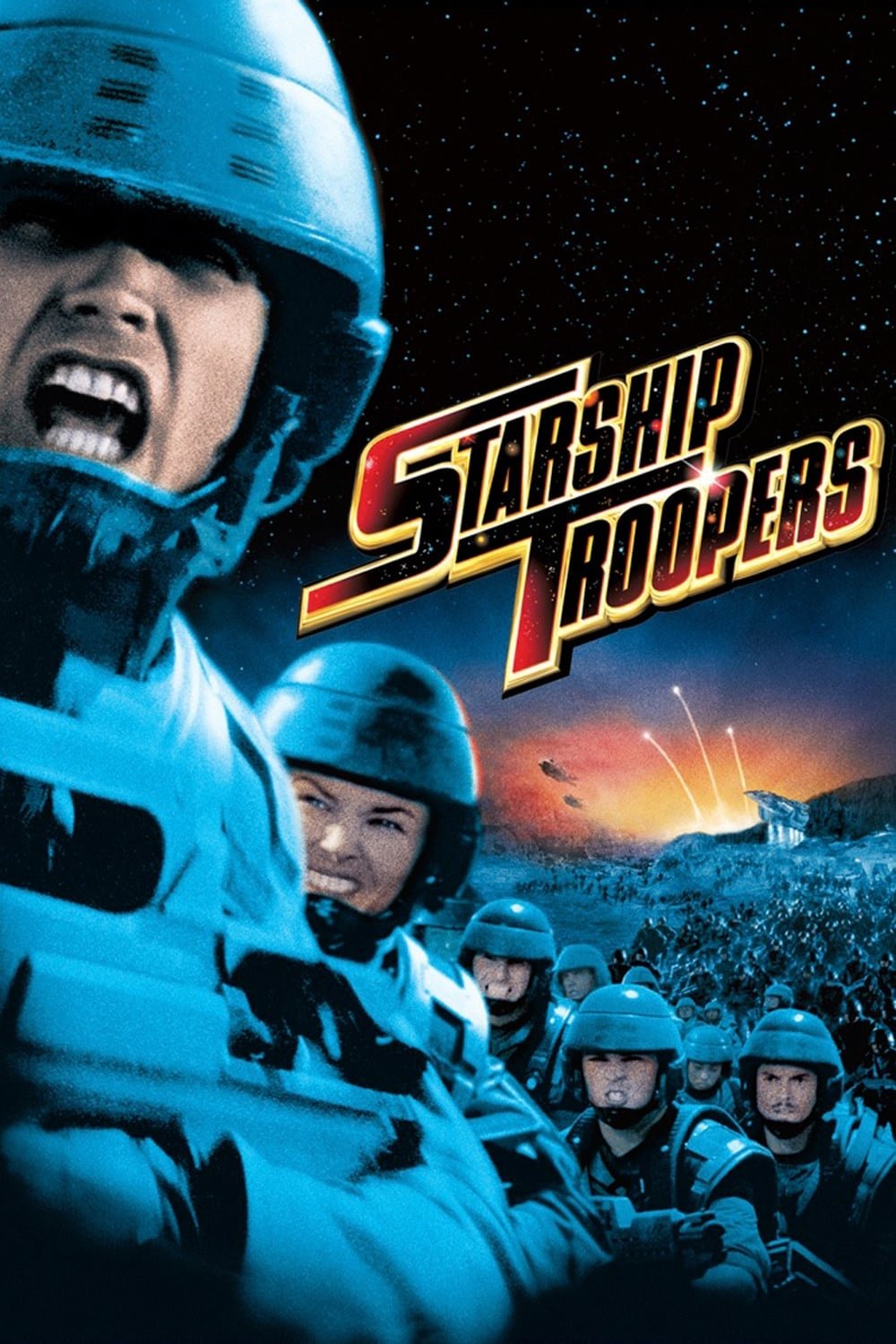
Starship Troopers (1997) at a Glance
| Premiere | November 4, 1997, Westwood, Los Angeles |
|---|---|
| US release | November 7, 1997 |
| Director | Paul Verhoeven |
| Screenplay | Edward Neumeier, based on Robert A. Heinlein’s 1959 novel |
| Producers | Jon Davison and Alan Marshall |
| Starring | Casper Van Dien, Dina Meyer, Denise Richards, Jake Busey, Neil Patrick Harris, Patrick Muldoon, Michael Ironside, Clancy Brown |
| Cinematography | Jost Vacano |
| Editors | Mark Goldblatt and Caroline Ross |
| Music | Basil Poledouris |
| Studios | TriStar Pictures and Touchstone Pictures |
| Running time | 129 minutes |
| Rating | R |
| Budget | $100 million to $110 million |
| Worldwide gross | About $121 million |
From Bug Hunt at Outpost 7 to Heinlein’s Novel
The film began as something else entirely. In 1991, screenwriter Edward Neumeier, the co-writer of RoboCop, wrote a treatment called Bug Hunt at Outpost 7, a comic, jingoistic war story about soldiers fighting insects with a teenage romance running through it. He chose insects because his wife was afraid of them. When he brought the idea to producer Jon Davison in December 1991, Davison noticed how closely it resembled Robert A. Heinlein’s 1959 novel Starship Troopers.
Studio executives at TriStar rejected the original treatment, but they were more receptive when Neumeier and Davison pitched an adaptation of the novel that used elements of his script. The rights were purchased, and Neumeier began reworking his story to fit Heinlein’s book. The novel had a divided reputation. It was admired by many readers for its defense of military service and necessary force, and it was attacked by others for the same reasons, with Heinlein labeled in turn a conservative, a militarist, a libertarian and a fascist.
Progress was slow. TriStar regularly replaced executives, and costly projects were scrutinized more closely, so the film waited for years. Davison spent 1993 securing key collaborators, including creature animator Phil Tippett and RoboCop director Paul Verhoeven, who had also made Total Recall and Basic Instinct. Neumeier and Davison believed Verhoeven was their only choice, because the monsters, the genre and the political subtext all suited his sensibility.
The Director Who Would Not Finish the Book
Verhoeven started to read the novel and could not get through it. He found it dull and too right-wing, and when Neumeier summarized the story for him, he found it militaristic and fascistic, which clashed with his own childhood in the German-occupied Netherlands during World War II. He decided to use the basic plot to satirize the book’s themes, deconstructing militarism and totalitarianism from the inside. He later described the characters as fascists who are unaware of their own fascism.
The strategy was to make the world seductive. Verhoeven wanted a society in which everyone is beautiful, everything is shiny and the technology is spectacular, so that the audience would be drawn in before it noticed what the society was for. The United Citizen Federation, a stratocracy in which citizenship is earned only through federal service, borrows its look from real history: the flag resembles the Nazi coat of arms, officer uniforms recall the Gestapo, and the infantry insignia references Mussolini’s Blackshirts. The film’s opening recruitment ad echoes scenes from Leni Riefenstahl’s Triumph of the Will, and the casting itself was designed around a Riefenstahl-style ideal.
Verhoeven also drew on Susan Sontag’s 1975 essay “Fascinating Fascism,” which identifies the cult of beauty and the fetishism of courage in Nazi imagery. He described the script as being about contemporary American politics, including loose gun laws and a rising use of capital punishment, which he believed could eventually lead to fascism. A director’s politics and visual language often go together, and Every Movie Plug explores more of those pairings in Five Directors, Five Visions: The Signature Styles of Hollywood’s Defining Filmmakers.

The Bug Test That Fooled the Studio
By 1994, TriStar was still reluctant to commit. Verhoeven, Davison and their crew decided to prove what they could do. TriStar paid $225,000 toward a short test sequence, filmed at Vasquez Rocks near Los Angeles on July 21, 1994, with a 30-person crew. It showed a soldier being chased and killed by two Warrior Bugs, animated by Tippett Studio, and it was shot while Verhoeven was still busy finishing Showgirls. When the footage was screened for studio executives, some of them did not realize the creatures were computer-generated.
That was enough to move the film into pre-production, but not enough to secure the money. A $90 million budget developed in early 1995 was turned down in the shadow of Waterworld, a $200 million flop that cost several Universal executives their jobs. TriStar’s parent company, Sony, brought in a partner: Disney’s Touchstone Pictures agreed to split the cost and the profits, in exchange for distribution rights outside the United States and Canada. Verhoeven later suggested that the constant executive turnover at TriStar actually helped, because the project was overlooked until it was too late to cancel.
Casting Beautiful People on Purpose
Verhoeven wanted a cast who embodied the blonde, blue-eyed ideal he saw in Nazi propaganda films. He looked first for popular young film actors, but found that stars such as Chris O’Donnell and Christian Slater were already in their thirties or committed elsewhere. The production turned to television, including Melrose Place and Beverly Hills, 90210, where it found Casper Van Dien, Denise Richards and Dina Meyer.
Van Dien auditioned five times for Johnny Rico and then underwent eight months of training. Mark Wahlberg and Matt Damon also auditioned, but Verhoeven felt Van Dien fit the aesthetic. Richards also auditioned five times for Carmen Ibanez, while Meyer chose to pursue the role of Dizzy Flores because she felt she could convey the character’s heart and vulnerability. Neil Patrick Harris, then best known for Doogie Howser, M.D., wanted a project that would change his image, and took the role of the psychic Carl Jenkins. Clancy Brown played the drill sergeant Zim, drawing on earlier military films and advice from a retired Marine captain, and Michael Ironside returned to work with Verhoeven after Total Recall.
The cast was later criticized as a group of models with limited range, and Verhoeven himself acknowledged that the film might have benefited from actors cast for ability rather than looks. Near-misses like those of Wahlberg and Damon are part of film history, and Every Movie Plug collects more of them in 10 Actors Who Turned Down Roles That Became Legendary.
Blizzards, Bentonite Mud and Thirteen Hundred Extras
Alien planets were built in the American West. Location scouts picked Hell’s Half Acre near Casper, Wyoming, for the planets Klendathu and Planet P, and Barry Barber Ranch and the Badlands National Park in South Dakota for Tango Urilla. The Wyoming site was remote, about an hour from the production office and hotels, and the crew had to build roads and carry anything that could not be trucked in by helicopter. It was also full of rattlesnakes.
Before filming, the main cast and 24 extras spent twelve days in military training led by retired Marine captain Dale Dye, starting April 17, 1996. They slept in open tents through a blizzard that left two feet of snow and ice. Principal photography began on April 29, 1996, and the location delivered 115-degree heat, freezing nights and 80-mile-per-hour windstorms. Torrential rain mixed with bentonite in the soil turned the ground into a slick that swallowed electrical cables, equipment and even cars, forcing an evacuation. Jake Busey was treated for heat stroke, a pause that cost the production $1.5 million a day. A night battle sequence on Klendathu used about 1,300 extras each evening.
Principal photography wrapped on October 16, 1996, only slightly over schedule. The mud-streaked trench warfare of the finished film owes a lot to those conditions, and it belongs in the same conversation as the productions covered in 20 Movies That Were Almost Impossible to Film.

500 Effects Shots and a Rescue by ILM
About half the budget went to the film’s 500 visual effects shots. Tippett Studio, which hired nearly 100 additional staff, handled the Arachnids, designing the Warrior, Tanker, Plasma, Hopper and Brain bugs with Verhoeven, Davison and Neumeier. Verhoeven insisted the bugs behave like insects rather than humanoids with weapons. Amalgamated Dynamics built two full-scale mechanized Warrior bugs that could lift an adult in their jaws, and miniatures of the ships measured up to 18 feet long.
The spaceship effects were a problem. Sony Pictures Imageworks was assigned the work because studio executives would not finance the film without using the in-house unit, but its contribution fell months behind and the completed shots were deemed insufficient. Industrial Light & Magic and Boss Film Studios were hired to finish the job. The result earned an Academy Award nomination for Best Visual Effects for Tippett, Scott E. Anderson, Alec Gillis and John Richardson.
Basil Poledouris and the Sound of Duty
Composer Basil Poledouris, another RoboCop veteran, wrote the score over six months. He planned an action score, but Verhoeven wanted music that supported the characters’ experience, so Poledouris concentrated on excitement, passion and poignancy. The theme for the spaceship Rodger Young, “Klendathu Drop,” became the basis of the overall score, and he wrote a theme for the relationship between Rico and Dizzy, whom he saw as the film’s heart. He deliberately wrote no theme for the Arachnids, so that their distinctive noises would contrast with the music. A 97-piece orchestra recorded the score between June and September 1997, and a band including Poledouris’s daughter performed two songs at the prom, one of them a lyrically altered David Bowie composition.
A Release Date That Kept Moving
The film was first scheduled for July 2, 1997, then moved to July 25, then to September and finally to November 7. The delays gave the effects team more time and the publicity more room, but they also meant a film built to be a summer blockbuster arrived after the peak season, partly because Sony had higher commercial hopes for Men in Black and Air Force One. Producer Alan Marshall said nobody involved was happy about it. The first trailer had appeared in front of Star Trek: First Contact on November 22, 1996, almost a year before release.
After a Westwood premiere on November 4, 1997, Starship Troopers opened on November 7 in 2,971 theaters, earning about $22.1 million over the weekend, an average of $7,424 per theater, and finished first ahead of Bean and I Know What You Did Last Summer. A week later it dropped 54 percent to second place behind the opening of The Jackal, and by its third weekend it had fallen to seventh. It left the top ten by mid-December.
The film finished with about $54.8 million in North America and an estimated $66.3 million elsewhere, for a worldwide total of roughly $121 million. That placed it 34th among the year’s releases worldwide and left it well short of its budget. Davison reportedly told Verhoeven early on that the film would never earn its money back. Competition was heavy: The Lost World: Jurassic Park and The Fifth Element had already taken a share of the science fiction audience, and Titanic, about to open, would dominate theaters. For comparison, Every Movie Plug’s The Billion-Dollar Club: The 10 Highest-Grossing Movies of All Time puts that blockbuster year in perspective.
The Reviews: Fascism, Gore and Dismissive Notices
Reviews were largely negative, and audiences polled by CinemaScore gave the film a C-plus. Many reviewers did not read it as satire. The Washington Post published an editorial describing the film as pro-fascist, and critic Stephen Hunter argued that it was spiritually Nazi and a perversion of All Quiet on the Western Front. Empire’s Adam Smith suggested that the weaponry and the Aryan cast made it look as if Verhoeven admired Heinlein’s world more than he claimed.
Some critics saw the joke but remained unconvinced. Roger Ebert and Owen Gleiberman recognized the satire but felt it was often indistinguishable from the thing it was lampooning. Salon argued that satire is self-defeating when the audience is meant to care about the characters, and the Los Angeles Times wrote that Verhoeven had lost his touch. Others offered qualified praise: Kenneth Turan and James Berardinelli found the film more jaw-dropping and digestible than many of that year’s blockbusters, and Berardinelli said it replicated the thrills of Aliens at its best and the tone of Beverly Hills, 90210 at its worst. The cast was widely dismissed, and the film was nominated for Worst Picture at the Stinkers Bad Movie Awards, where it lost to Batman & Robin.
Verhoeven believed the Nazi accusations dissuaded audiences from seeing the film, and that poor word of mouth from those who did made things worse. He also blamed the American marketing, which presented the film as an action movie and so led critics and viewers to miss the satire. Observers have pointed out that the film’s title suggested a light-hearted adventure in the vein of Star Wars, and Verhoeven said it was marketed more clearly as satire in England.
What the Satire Is Actually Saying
Read today, the film’s method is easy to see. The FedNet broadcasts, a news service invented for the movie, show children stamping on cockroaches while adults beam, and they offer slogans such as “Service guarantees citizenship.” The repeated question “Would you like to know more?” invites viewers to click deeper into a system they have already accepted. The writer Darren Mooney considered the FedNet prescient of the rise of fake news, and Verhoeven said the question was asking whether the audience wants to dive even further into a system that already exists.
The film also quietly argues with itself. Humanity is presented as the victim of the Arachnids, but hints throughout suggest that people may have provoked the war by colonizing Arachnid worlds. A journalist who asks whether the bugs would be hostile if left alone is killed in a bloody display, which erases his argument. The soldiers’ orders are to kill anything inhuman, and strategic failures are answered with more soldiers. By the end, the survivors do not oppose the system but become part of its recruitment propaganda.
Scholars have added complications. In the novel, Rico is revealed at the end to be Filipino, a choice meant to make readers empathize before revealing he is not white; Verhoeven made him white to sharpen the satire. Professor Lene Hansen argued that, despite the film’s apparent equality between men and women, Dizzy’s sacrifice is romantic and so reinforces traditional gender roles. Others have described the film as an example of Poe’s law, in which a view is presented so extremely that it becomes impossible to tell whether it is parody. Villains and systems that mirror the audience’s own assumptions are a recurring subject for Every Movie Plug, and When Movie Villains Were Right: 10 Antagonists Who Had a Point explores a related idea.

Reappraisal: From Flop to Cult Classic
The reputation shift came gradually. By 2013, The Atlantic’s Calum Marsh wrote that the film’s critical standing was moving in a positive direction, with some calling it an unsung masterpiece. Retrospectives through the 2010s and 2020s described it as one of the most misunderstood Hollywood studio films, released in a prosperous era when American audiences may not have wanted to see the critique. A 2020 Guardian retrospective placed it as the final part of an unofficial Verhoeven trilogy about authoritarian governance, following RoboCop and Total Recall, and the British Film Institute named it one of the ten greatest science fiction adaptations in 2021.
The numbers reflect the shift. Rotten Tomatoes lists a 72 percent approval rating from 82 critics, with a consensus calling it a fun movie if viewers can accept the excessive gore and wooden acting, while Metacritic gives it 51 out of 100 from 20 critics. Ari Aster, Quentin Tarantino, Edgar Wright, Robert Rodriguez, James Wan and Takashi Miike are among the filmmakers who have named it as an influence or favorite, and its slogans entered the cultural vocabulary. Its influence is visible in Futurama, in the anime Kaguya-sama: Love Is War and in the 2024 video game Helldivers 2, whose popularity led to a new wave of interest in the film. Even so, discussion remains divided: a 2024 analysis by Vice described modern opinion as split between those who praise the satire and those who believe the film still glorifies its Aryan heroes and their militarized society.
Other science fiction films with a delayed reputation are covered elsewhere in this series, including Today in Cinema, November 5: The Matrix Revolutions Ends the Trilogy in 108 Territories at Once.
After 1997: Sequels, Home Video and a Blomkamp Reboot
The failure of the film ended hopes of a theatrical sequel. Verhoeven went on to make Hollow Man in 2000, then returned to Europe and made Black Book in 2006 and Elle in 2016. The franchise continued without him: Starship Troopers 2: Hero of the Federation (2004), directed by Phil Tippett, and Starship Troopers 3: Marauder (2008), written and directed by Neumeier, both went direct to home media, followed by the animated Starship Troopers: Invasion (2012) and Traitor of Mars (2017). A 40-episode animated series, Roughnecks: Starship Troopers Chronicles, ran in 1999, and the property also produced video games, comics, toys and a pinball machine.
Home video helped the film find its audience. It arrived on VHS in 1998 and DVD in 1999, with a two-disc special edition in 2002, a Blu-ray in 2008 and a 4K Ultra HD release for the 20th anniversary. A 25th-anniversary 4K steelbook in 2022 included a reunion discussion with Neumeier, Van Dien, Richards, Meyer, Ironside, Brown, Busey and Gilliam.
In March 2025, Sony confirmed a new Starship Troopers film to be written and directed by Neill Blomkamp, the director of District 9, with his wife and collaborator Terri Tatchell producing. Reports said it would not remake Verhoeven’s film but would return to Heinlein’s novel. As of the latest reports in mid-2026, there has been no further public update on casting or a release date.
How to Watch It Today
The film is available on DVD, Blu-ray and 4K Ultra HD Blu-ray, and it appears on streaming services from time to time, though availability changes often, so check current listings. The home releases are worth seeking out for their extras, which include commentary by Verhoeven and Neumeier, screen tests, effects breakdowns and a deleted alternative ending in which Rico and Carmen reunite. The Blu-ray’s FedNet mode adds pop-up facts to the film.
A good approach is to watch it twice, once for the spectacle and once for the framing. On a second viewing, details such as the ad breaks, the uniforms, the boot camp slogans and the final recruitment broadcast play very differently. For the original Godzilla, another film whose political meaning shaped its legacy, see Today in Cinema, November 3: Godzilla Rises From Tokyo Bay in 1954.
Frequently Asked Questions About Starship Troopers
When was Starship Troopers released?
It premiered in Westwood, Los Angeles, on November 4, 1997 and opened in United States theaters on November 7, 1997.
Is Starship Troopers a satire?
Yes. Director Paul Verhoeven and writer Edward Neumeier intended it as a satire of militarism and fascism, but many critics at the time read it as sincere, and the confusion hurt its reception.
How much money did Starship Troopers make?
It earned about $54.8 million in the United States and Canada and roughly $121 million worldwide against a budget of $100 million to $110 million.
Why did Starship Troopers flop?
Retrospectives point to negative reviews and word of mouth, a Washington Post editorial calling it pro-fascist, marketing that sold it as an action movie, and heavy competition in 1997, including Titanic.
Did Starship Troopers get an Oscar nomination?
Yes. Phil Tippett, Scott E. Anderson, Alec Gillis and John Richardson were nominated for Best Visual Effects at the 70th Academy Awards.
Is there a new Starship Troopers movie?
Sony announced in March 2025 that Neill Blomkamp would write and direct a new film that returns to Robert A. Heinlein’s novel. No release date or cast has been confirmed.
Conclusion: The Joke the Audience Had to Catch Up To
Starship Troopers is a film that was wrong for its moment and right for several that followed. It was too gory for a family audience, too sly for a straightforward action crowd and too glossy for critics who wanted their satire obvious. Nearly three decades later, its slogans, its propaganda and its smiling soldiers read as a warning rather than a misfire, and its reputation has been rebuilt on exactly the elements that once sank it.
Today in Cinema returns with another film from movie history. Recent entries include The Departed, American Gangster and Nightcrawler.
Image and Source Credits
- Lead image and three scene images: TriStar Pictures and Touchstone Pictures, via TMDB
- Related-story thumbnails: Every Movie Plug
References and Further Reading
- Development, production, release, reception, themes and legacy: Starship Troopers (film), Wikipedia
- Box office and release data: The Numbers; Box Office Mojo; IMDb
- Critical reception: Rotten Tomatoes; Metacritic; The Atlantic
- Studio context: D23, The Official Disney Fan Club
- The Blomkamp project: The Playlist; Dark Horizons
News
More on Every Movie Plug
 Film News Jeremy Allen White: The Next Wolverine? A report from Jeff Sneider says The Bear star Jeremy Allen White sat down with Marvel about a small part that could grow. Marvel has confirmed nothing. Read the story →
 Film News Who Will Be the Next James Bond? Casting Reportedly Narrows to a Short List Reports name Jack Lowden, Jacob Elordi, Callum Turner and Josh O’Connor among the actors in the running for James Bond, with final screen tests reportedly set for the coming week. Read the story →
 Film News Johnny Depp Says He Would Return for Pirates of the Caribbean 6 to Give Jack Sparrow a Better Send-Off Depp stopped short of confirming a return, but told Entertainment Tonight he would work with producer Jerry Bruckheimer on anything as the long-delayed sixth film remains in development at Disney. Read the story →
Articles
Latest on Every Movie Plug
 Article The Ending of The Graduate: Why Benjamin and Elaine Stop Smiling How Mike Nichols turned a wedding-crash rescue into one of cinema’s most debated final shots. Read the article →
 Today in Cinema Today in Cinema: The Departed Turns 20, and Scorsese’s Remake of Infernal Affairs Still Plays Like a Trap Door How Scorsese remade Infernal Affairs, the casting near-misses, the Whitey Bulger link and the Oscar that finally came. Read the story →
 Today in Cinema Today in Cinema, November 5: The Matrix Revolutions Ends the Trilogy in 108 Territories at Once A record-setting global opening, a record-setting drop and an ending that critics and fans have argued about for 23 years. Read the article →
 Today in Cinema Today in Cinema, November 3: Godzilla Rises From Tokyo Bay in 1954 and Changes Monster Movies Forever A cancelled co-production, a fishing boat showered in fallout and a stuntman who could last three minutes in a rubber suit launched the longest-running franchise in film. Read the article →